
Real Estate News
Maharashtra to Launch New Property Card System for Flats and Landowners

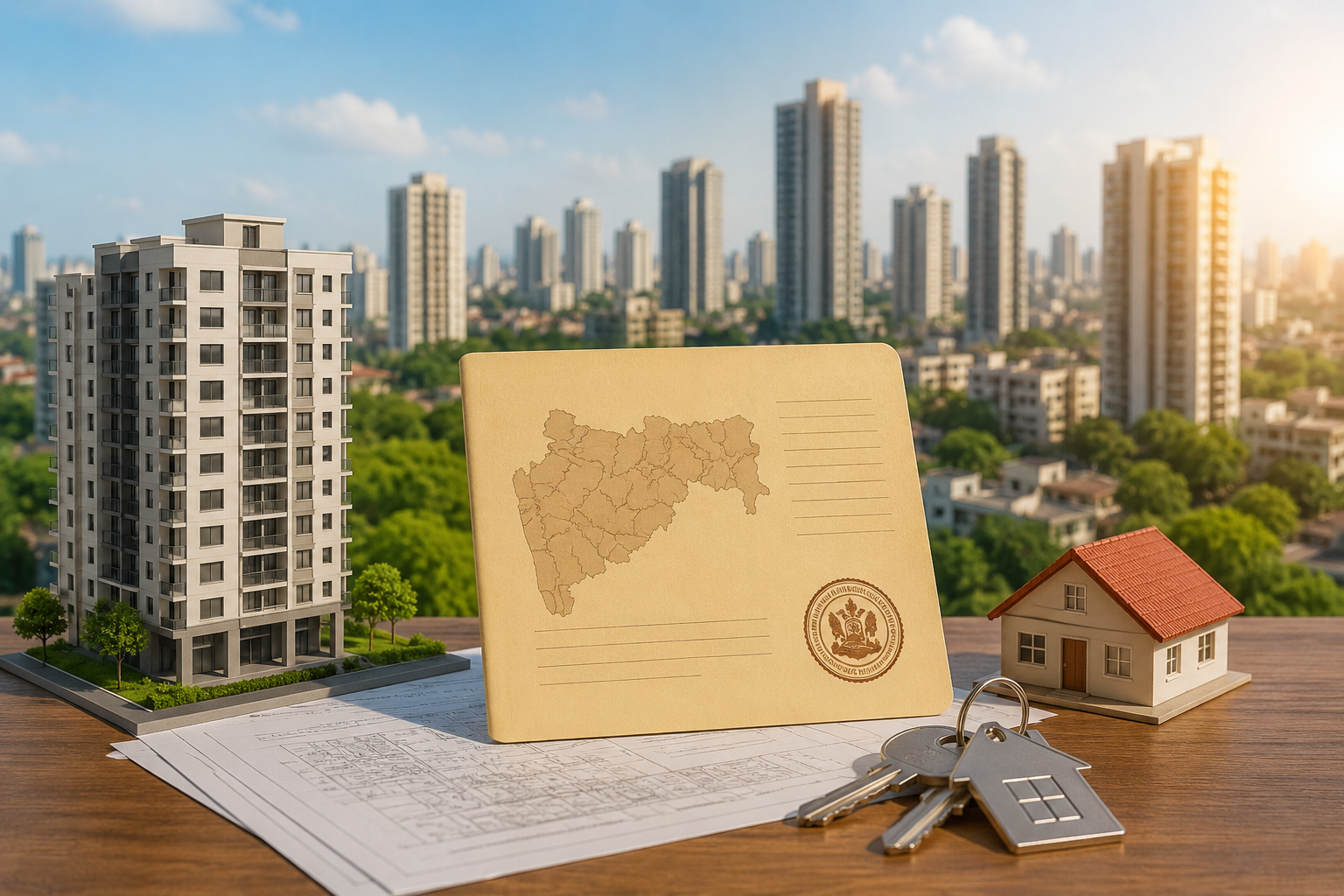
The Maharashtra government is preparing one of the biggest property ownership reforms in recent years through its proposed Land Titling Act. The initiative aims to modernise the state’s land and housing records by introducing official property cards for both land parcels and apartment units. The proposed system is designed to create a transparent, legally verified, and digitally traceable ownership structure that could significantly reduce confusion in property transactions across the state.
At present, property ownership in many parts of India often relies on multiple documents such as sale deeds, society records, registration papers, and revenue extracts. This fragmented system frequently creates disputes over ownership, inheritance, redevelopment rights, and land boundaries. Maharashtra’s proposed reform seeks to establish a single government-recognised ownership record that clearly identifies the legal owner and the property’s official valuation.
One of the most important changes under the proposed law is the introduction of “Vertical Property Cards” for apartment owners. Traditionally, land records are maintained horizontally, meaning the land parcel is recorded but individual apartments inside a building are not separately reflected in official revenue documents. Under the new framework, each apartment owner would receive an independent property card linked directly to their specific flat.
These vertical property cards are expected to include detailed information such as the flat’s carpet area, ownership details, proportionate share in the land, floor location, mortgage status, and other legal identifiers. This would provide apartment owners with stronger legal recognition and more secure documentation beyond the standard sale agreement or share certificate currently used in housing societies.
The reform could bring major benefits to homebuyers and property owners across Maharashtra. Property verification during resale transactions may become faster and more reliable, reducing the risk of fraud or title-related disputes. Banks and financial institutions may also find it easier to process home loans and mortgage approvals due to the availability of government-backed ownership records.
Real estate experts believe the move could increase transparency in redevelopment projects as well. In cities like Mumbai, where redevelopment disputes are common, clearly defined ownership records for every flat could simplify consent processes and improve confidence among residents. The new system may also help government authorities streamline taxation, urban planning, and infrastructure mapping.
The proposal is expected to benefit future residential developments registered under MahaRERA by ensuring that ownership data is digitised from the beginning of the project lifecycle. Over time, the state could build a centralised property database that integrates registration records, land surveys, municipal approvals, and property valuations into one connected framework.
Experts say that if implemented effectively, the Land Titling Act could transform Maharashtra’s real estate ecosystem by making ownership records more accurate, legally secure, and accessible. For millions of apartment owners, especially in urban areas, the introduction of vertical property cards may represent a major shift toward stronger property rights and a more organised housing market.


Maharashtra is considering a major change in the way property developers collect money from homebuyers.
The state government is planning an amendment that could restrict developers from collecting more than around 75–80% of the property’s total consideration before the project’s final completion and registration. The remaining amount could be retained by the buyer until the final registration stage.
The proposal is aimed at reducing the financial risk faced by homebuyers, particularly those purchasing under-construction properties.
The development is important for Mumbai because the city’s property market has a large under-construction segment, where buyers often commit substantial amounts of money years before receiving possession.
According to recent reporting, the Maharashtra government is looking at amendments to the Registration Act that could prevent developers from taking the entire property consideration before completion. The exact percentage and implementation mechanism will depend on the final legislation or notification.
What Is the Proposed 80% Rule?
Under the proposal being discussed, a developer may be allowed to collect only around 75–80% of the property’s total consideration before final registration.
For example, suppose a homebuyer purchases a flat worth ₹1 crore.
Under a possible 80% framework:
- Property value: ₹1 crore
- Maximum amount before final registration: around ₹80 lakh
- Amount retained until registration: around ₹20 lakh
The exact structure should not be assumed until the government formally notifies the provision.
The key idea is that the buyer would retain a meaningful financial stake until the property reaches the final stage of the transaction.
Why Is This Important for Homebuyers?
Buying an under-construction home involves a major financial risk.
A buyer may begin paying for the property while construction is still underway. If the project faces delays, approval problems, funding issues or other difficulties, the buyer may have already paid a significant portion of the purchase price.
The proposed mechanism could change that risk equation.
If 20% of the consideration remains payable until final registration, buyers may have greater financial leverage during the final stage of the transaction.
This does not eliminate project risk.
It also does not mean buyers should stop checking the developer’s track record or project documents.
Instead, it could become an additional layer of protection.
What Could It Mean for Mumbai Buyers?
Mumbai has one of India’s most expensive residential markets.
For a ₹2 crore apartment, 20% represents ₹40 lakh.
For a ₹3 crore apartment, it represents ₹60 lakh.
Therefore, even a relatively small change in the payment structure could have a substantial financial impact on buyers.
For example, a buyer who is purchasing a ₹2 crore under-construction apartment could potentially retain around ₹40 lakh until the final registration stage if the final rule establishes an 80% threshold.
That could reduce the amount of money exposed before the property reaches its final legal and completion stage.
Will This Stop Delays?
Not necessarily.
This is one of the most important points homebuyers should understand.
A payment restriction cannot by itself guarantee timely possession.
Construction delays can happen because of approvals, financing, litigation, contractor issues, changes in plans or other circumstances.
The buyer must therefore continue to examine the possession date, construction progress and contractual remedies.
MahaRERA itself requires promoters to keep important project information updated, including construction progress, building details, documents, encumbrances and completion dates.
What Should Buyers Check Before Booking?
Even if the proposed rule becomes law, buyers should conduct their own due diligence.
1. Check MahaRERA Registration
Search the project on the official MahaRERA portal.
MahaRERA provides facilities for homebuyers to search registered projects and access project-related information.
2. Check the Completion Date
Don’t rely only on a sales representative’s verbal promise.
Compare the proposed possession date with the project’s official MahaRERA information and the Agreement for Sale.
3. Read the Agreement for Sale
The agreement should clearly specify the property, carpet area, consideration, payment schedule, possession terms and other important obligations.
4. Check Approvals
Buyers should verify whether the relevant approvals and commencement certificates are in place.
MahaRERA’s project-registration requirements include approvals, commencement certificates, sanctioned plans, project details and the proposed Agreement for Sale.
5. Examine the Developer’s Track Record
A large brand name should not replace due diligence.
Look at previous projects, delays, litigation, possession history and customer complaints.
Could Developers Be Affected?
The proposed rule could also change developers’ cash-flow planning.
Under the traditional construction model, customer collections are an important source of project funding.
If a portion of the consideration remains outstanding until final registration, developers may need stronger project-level financial planning.
This could potentially favour financially stronger developers who have access to institutional finance and other sources of capital.
Smaller developers may need to adapt their funding models.
Is the 80% Rule Already Law?
This distinction is extremely important.
No homebuyers should not treat the proposal as an already applicable rule.
The current reports describe a proposed change being considered by the Maharashtra government. The final percentage, conditions, applicability and effective date will depend on the government’s formal legal process.
Therefore, buyers should check the latest government notification before assuming that they can legally withhold a particular amount.
What Should Existing Buyers Do?
Existing buyers should not independently stop making scheduled payments simply because the proposed rule has been reported.
The payment obligations under their existing Agreement for Sale remain important.
If there is a dispute regarding payment, possession or construction, buyers should obtain professional legal advice and examine the applicable RERA provisions and contractual terms.
Bottom Line
Maharashtra’s proposed payment restriction could become an important development for homebuyer protection.
If implemented, retaining around 20% of the property consideration until final registration could give buyers greater financial leverage and reduce the amount of money paid before a project reaches its final stage.
But the proposal should not be viewed as a replacement for due diligence.
For Mumbai homebuyers, the safest approach remains the same: verify MahaRERA, check approvals, study the Agreement for Sale, investigate the developer’s track record and understand the payment schedule before committing large amounts of money.

India’s residential real estate market is showing an interesting shift in 2026: home sales are slowing, but property prices continue to rise.
According to the latest Real Insight Residential Q2 2026 report by PropTiger, 91,729 homes were sold across India’s top eight residential markets during the second quarter of 2026. That represents a 6.1% decline compared with the same period last year and a 4.4% drop from the previous quarter.
At the same time, the average sales-weighted residential property price increased 1% quarter-on-quarter to ₹10,153 per sq ft, keeping the national average above the ₹10,000-per-sq-ft mark for the second consecutive quarter.
The numbers point towards a market that is not necessarily weakening, but one where buyers are becoming more selective while developers continue to maintain pricing power.
Home Sales Slow Despite Rising Property Prices
The Q2 2026 numbers reveal a widening gap between sales volumes and property prices.
Developers launched around 89,161 new housing units across the top eight cities during the quarter, compared with 91,729 homes sold. While sales declined, new launches were down 4.2% sequentially but remained 6% higher than a year earlier.
The fact that sales continue to exceed fresh supply is important. It indicates that the market has not yet entered a phase of significant inventory accumulation.
However, the decline in sales suggests that buyers are becoming increasingly cautious, particularly as property prices and overall homeownership costs rise.
For middle-income homebuyers, the question is becoming increasingly straightforward: How much more can property prices rise before affordability starts affecting demand?
Bengaluru Leads India’s Property Price Growth
Bengaluru has emerged as one of the clearest examples of the changing affordability equation.
Residential prices in Bengaluru jumped 26% year-on-year to ₹9,931 per sq ft, the highest annual price increase among the eight major markets tracked in the report.
Interestingly, sales in the city declined 9.2% YoY during the same period.
This combination of rising prices and falling sales could indicate that buyers are becoming more price-sensitive.
Pune also crossed an important threshold, with average residential prices reaching ₹8,084 per sq ft, representing a 13.7% annual increase.
These markets highlight a broader trend across India’s urban housing sector: premiumisation continues, but affordability is becoming a more important consideration.
Mumbai MMR Remains India’s Biggest Housing Market
For Mumbai’s real estate market, the numbers remain particularly significant.
The Mumbai Metropolitan Region (MMR) continued to be India’s largest residential market by both sales volume and value.
The region recorded 24,112 home sales during Q2 2026, with the average property price reaching ₹15,422 per sq ft. Prices increased 20.4% year-on-year, while sales declined around 7% compared with the previous year.
Mumbai’s performance reinforces the city’s position as one of India’s most valuable residential markets.
Limited land availability, redevelopment activity, infrastructure investment, premium housing demand and strong interest in established locations continue to support property values across the MMR.
However, the combination of high prices and softer sales also suggests that buyers in Mumbai are becoming more selective about location, apartment size, amenities and overall value.
Not Every City Is Seeing Sales Decline
Despite the national slowdown, housing demand remains strong in several markets.
Chennai recorded the strongest annual growth in sales, with volumes increasing 36% YoY to 7,183 units.
Hyderabad also performed strongly, with 13,196 homes sold during the quarter, representing 14.6% annual growth.
Kolkata recorded a particularly strong sequential recovery, with sales increasing 22% compared with the previous quarter.
On the other hand, Pune and Ahmedabad recorded annual sales declines of 20.8% and 20.2%, respectively.
This uneven performance shows that India’s residential market cannot be viewed as a single market. Local employment conditions, infrastructure, affordability, supply, investor sentiment and buyer demographics are increasingly influencing individual city markets.
Premium Homes Continue to Drive the Market
One of the biggest trends emerging from the latest data is premiumisation.
Despite weaker overall sales volumes, higher-priced homes continue to find buyers in major Indian cities.
This suggests that demand has not disappeared. Instead, the composition of demand may be changing.
Higher-income buyers continue to have purchasing power, while middle-income buyers are becoming more cautious about taking on large home loans at elevated property prices.
For developers, this creates an incentive to focus on projects with stronger locations, better amenities and higher ticket sizes.
For buyers, however, rising prices mean that the same budget may now purchase a smaller home or require moving further away from established locations.
Why Are Property Prices Still Rising?
A key question is why prices are increasing even though sales have moderated.
One explanation is the relatively balanced demand-supply situation.
With 91,729 homes sold against 89,161 new launches, developers have not flooded the market with excess inventory. This supply discipline can help support pricing even when sales volumes moderate.
Construction costs, land prices, redevelopment expenses and infrastructure-led appreciation are also important factors influencing residential prices.
In several major cities, improved connectivity and infrastructure are increasing the attractiveness of emerging micro-markets, allowing developers to command higher prices.
Is India’s Housing Market Becoming Too Expensive?
The latest numbers do not suggest an immediate housing-market crisis.
Inventory has not risen sharply, sales remain substantial and developers continue to maintain supply discipline.
But affordability is becoming the biggest issue to watch.
Bengaluru provides a clear example. Prices rose 26% in one year even as sales declined 9.2%. Pune has crossed ₹8,000 per sq ft, while MMR’s average price is already above ₹15,000 per sq ft.
If prices continue rising faster than household incomes, more buyers could postpone purchases, reduce their budgets or shift towards smaller homes and peripheral locations.
That could eventually force developers to balance their desire for price appreciation with the need to maintain sales momentum.
What Could Happen During the Festive Season?
The upcoming festive quarter could provide an important test for India’s housing market.
Festive-season demand traditionally supports property purchases, while infrastructure development and improving connectivity could continue to support several major urban markets.
If home sales recover while prices remain elevated, it would strengthen the argument that India’s housing market is entering a more mature phase rather than experiencing a fundamental slowdown.
But if sales remain weak while prices continue climbing, affordability could become a much bigger concern for developers and homebuyers.
India’s residential real estate market is entering an interesting phase.
Home sales are cooling, but property prices are still climbing.
The latest Q2 2026 data suggests that India’s housing market is not facing a major demand-supply imbalance yet. Instead, buyers appear to be becoming more selective as prices rise.
For developers, the challenge will be maintaining sales momentum without pushing prices beyond what buyers can comfortably afford.
For homebuyers, the message is equally important: location, pricing, financing costs and long-term value matter more than ever.
The next few quarters will reveal whether India’s property market can continue its premiumisation trend or whether affordability eventually puts a stronger brake on demand.
For now, the market appears to be maturing rather than collapsing—but rising prices are making affordability the biggest question in Indian real estate.
The Bombay High Court has ruled that homebuyers who accept possession of a delayed project can still claim interest from the developer for the period of delay, rejecting a developer’s argument that homebuyers lose this right if they accept possession without first notifying the developer of their intention to seek compensation.
The Bombay High Court stated that the allottee (homebuyer) has the right to receive interest for each month of delay until ownership is handed over in line with the parties’ agreement, and that this right is independent and indefeasible.
The decision came after a developer filed an appeal against homebuyers who bought homes in the free-sale component of the Patra Chawl project in Mumbai’s Goregaon. In a ruling dated August 5, 2026, the Bombay High Court denied the developer’s appeal while upholding the prior findings of the Maharashtra Real Estate Appellate Tribunal (MREAT).
The case
The dispute is over a flat for a project in Mumbai’s Goregaon, with possession expected by June 30, 2018. The developer contended that, notwithstanding the delay, the homebuyers accepted ownership without giving notice of their intention to seek compensation for the delay. It used provisions of the Indian Contract Act to argue that the homebuyers couldn’t seek compensation for the delay.
Bombay HC’s take
The Bombay High Court dismissed the developer’s petition, finding that the requirements of the Real Estate Regulatory Act (RERA), 2016 take precedence over other legislation. More importantly for homeowners, the court stated that a homebuyer’s entitlement to collect interest for each month of delay until ownership is turned over is a “independent and indefeasible right” under the agreement.
In layman’s terms, the Bombay High Court ruled that just taking the keys to a property does not waive the ability to suspend interest payments. If the developer fails to give over control by the agreed-upon date, the buyer’s rights under Section 18 of RERA remain in effect.
The court further observed that the buyers had paid 95% of the sale price by December 2017 and had requested an inspection of the unit before taking possession. It upheld the determination that the developer failed to deliver possession and that the case constituted a violation of RERA Section 18.
The Bombay High Court eventually denied the developer’s petition, confirming the protections provided to homebuyers under RERA. It stated that the provisions of Section 18 are useful and meant to protect allottees, and that accepting the developer’s claim would contradict the objective of the Act.
What is the Patra Chawl Redevelopment Project?
Patra Chawl, located in the Siddarth Nagar section of Goregaon, a western suburb of Mumbai, was redeveloped in 2008. It housed over 670 residents and covered 47 acres.
Patra Chawl was initially a barrack built by the British during World War II and used as a military camp.
In 2008, MHADA began the reconstruction project, appointing Guru Ashish Construction Private Limited (GACPL), a sister business of real estate firm Housing Development and Infrastructure Ltd (HDIL), to rehabilitate over 670 tenants and renovate the area.
A tripartite agreement was signed between GACPL, the tenants’ society, and MHADA. Following this, the residents moved out of the chawl in 2010, but 14 years later, they have yet to receive their promised dwellings.
In addition, under the agreement’s free-sale provision, developers sold units to around 1,700 families. The real estate businesses that have been involved in this for over a decade and built these projects are unable to transfer up possession due to a lack of OC. Home buyers claimed that their possession was delayed due to administrative hurdles and disagreements between developers and MHADA over pending liabilities of around ₹3,100 crore.

Mumbai Police Book 2 Goa Residents in ₹41 Lakh Real Estate Extortion Case

Chembur’s ₹142 Crore Deal

SCLR Phase-II

43,000 Homes Unsold in Navi Mumbai Amid Buyer Slowdown

Vijayta Raheja Applauds India’s ₹4 Lakh Crore Urban Vision at ET Maharashtra Business Summit

K Raheja & IHG Team Up to Elevate Powai’s Hospitality Landscape
-
 Real Estate News5 months ago
43,000 Homes Unsold in Navi Mumbai Amid Buyer Slowdown
-
 Real Estate News4 months ago
Vijayta Raheja Applauds India’s ₹4 Lakh Crore Urban Vision at ET Maharashtra Business Summit
-
 New Projects & Launches5 months ago
K Raheja & IHG Team Up to Elevate Powai’s Hospitality Landscape
-
 Real Estate News5 months ago
Mumbai’s Largest MHADA Redevelopment Drive Set to Transform 923 Acres
-

 Global Real Estate5 months ago
Spanish Youth Hostel Group Considers London Real Estate Deals
-

 NRI Real Estate5 months ago
Will NRI Investments Drive Mumbai Housing?
-

 Real Estate News5 months ago
John Abraham Firm Renews Bandra Rent at ₹12L/Month
-

 NRI Real Estate5 months ago
How NRIs Are Driving India’s Property Market?