
Market Trends
Nutritious Lunch Ideas for Kids


Packing healthy school lunches can be difficult due to time constraints, your child’s food preferences, and habitual patterns that frequently influence decision-making. For example, you may be in the habit of purchasing single-serving packets of chips and putting them in your lunchbox. After all, it meets your children’s cravings while also making your morning routine easier—no decisions or preparation required. One of the keys to packing a healthier lunchbox—or changing any behavior—is to keep things simple. Read on for methods and recommendations.
Work together.
Healthy habits begin at home, so establish a solid foundation. Knowing that your other family members are on the same page boosts the group effort. Social support is an important role in developing healthy behaviors. Pack lunches for everyone in the family.
Create options
Choose a few different healthy foods to replace the less nutritious ones (examples provided below). Everyone prefers to feel in control. Keep it basic with two options. Set parameters and boundaries, then allow everyone to choose the option that appeals to them the most.
Spend the weekend brainstorming food ideas for the upcoming week. Request feedback from children. Find out what they enjoy and why. It will keep them more engaged with the mission and teach them about healthy eating. Make a game out of it by combining different colors of fruits and veggies. Include foods from each category: grains, dairy, fruits, veggies, and protein. Then go shopping together. Make it a routine, ritual, or habit. Make this a priority.
Gradual change is more sustainable
To enhance the likelihood of good habits staying, don’t overhaul lunchtime all at once. Replace one lunch box item at a time, week by week, and reassess frequently. Slow, persistent modification is more effective than abrupt menu changes. Set a theme for each week and vary the “healthy” portion of the meal. It could be the major item one week, the snack the next, and the beverage the following week.
Lunchbox Swaps
Before you switch from one food to another, examine your appetites. Discuss why certain foods are so delicious. Creamy, crunchy, salty, sweet, and savory are prevalent sensations that attract people to different dishes. Finding an option that falls into the same sensation category will help satisfy your craving for that dish.
Replace chips and pretzels with almonds, carrots, or celery. There is still a crunch, but the nutrients are more concentrated in the nutritious stuff.
Introduce flavored water instead of soda. Mix in a splash of fruit juice, lime, lemon, fresh fruit, or mint.
Instead of mayonnaise, spread hummus or avocado on your sandwich. Higher-quality meals provide a creamy and moist feel.
Rather than artificially flavored yogurt or ice cream, try plain yogurt blended with vanilla and honey.
To fulfill your sweet taste, snack on grapes, apples, peaches, dried mango, or other fruit rather than candy.
Instead of a candy bar, enjoy a piece of dark chocolate or some nuts.
Reward Yourself
Aside from health benefits, these meal choices can boost your children’s energy and concentration throughout the school day. When you start adopting these substitutions into your family’s routine, celebrate together! Find a weekly or monthly treat that the entire family can enjoy. A nutritious cooking lesson or a fun physical activity, for example, might help families stay fit after lunch.


According to the Confederation of Real Estate Developers’ Associations of India (CREDAI), development costs in India’s real estate sector have increased by more than 25% as a result of the ongoing US-Iran conflict. Several listed developers have also expressed concern about rising input costs, warning that if geopolitical tensions persist, project viability and delivery deadlines will suffer.
Industry players have also warned that the difficulty goes beyond growing prices, with certain vital construction materials being difficult to obtain regardless of price, a condition rarely seen in the sector.
As supply restrictions begin to affect availability, project timetables may be strained, prompting developers to diversify procurement channels, boost domestic sourcing, and reorganize construction plans in order to minimise delays and preserve execution momentum.
Real estate developers such as Oberoi Realty, Lodha Developers, Rustomjee Group, and Raymond Realty, among others, have highlighted rising construction costs and growing cost pressures in the sector, citing rising raw material, labour, and overall project execution costs.
Why are construction costs rising as a result of the war between the United States and Iran?
The US-Iran confrontation has pushed up crude oil prices and interrupted global shipping lines, putting pressure on construction costs in India’s real estate sector. The rise in fuel costs has raised transportation and logistics costs, while important inputs such as steel, cement, and other building materials have grown more expensive, creating the prospect of greater project costs and property prices.
CREDAI says construction cost up by 25%
The current global conflict is another test of that resiliency. Since the start of hostilities, construction expenses have risen by more than 25%, indicating a significant and urgent need for care. However, the organised sector now is significantly better suited to deal with such issues than in earlier cycles,” said Shekhar Patel, president of CREDAI National.
Certain crucial materials are unavailable in the market, regardless of price, which is a rare occurrence in the field. When procurement becomes a constraint beyond pricing, project timetables are naturally put under strain, pushing developers to rearrange procurement pipelines, accelerate domestic sourcing, and reschedule construction activity to preserve momentum wherever possible,” Patel added.
According to CREDAI, pressure on the supply chain has increased as labour moves away from metropolitan building regions owing to gasoline shortages. This combined problem of materials and personnel requires both industry flexibility and policy support. On that front, CREDAI has contacted the Union Housing Ministry, requesting suitable RERA timeframe relief to protect both developers and homebuyers.
Earlier this month, HT Real Estate reported that CREDAI had written to the Ministry of Housing and Urban Affairs, urging it to direct state RERA authorities to grant a blanket extension of three to six months for project completion timelines and to declare the current situation a force majeure event for the real estate sector.
The developers’ group stated that delays in raw material supply, combined with labor shortages caused by the crisis, have hampered building activity and delayed project completion across the country.
What are the listed developers saying?
During Lodha Developers’ Q4FY26 earnings call earlier this month, Abhishek Lodha, CEO and MD, stated that the Middle East turmoil is now impacting building costs by 3-5% of total costs. He stated that gas-dependent material categories had been the most affected, with the total impact on margins remaining’very modest.’
“We estimate that the impact of construction cost hikes is now between three and five percent of total construction costs. Gas-dependent categories are the most heavily affected. This includes tiles, paints, PVC pipes, aluminum formwork, and some waterproofing materials,” Lodha stated.
Oberoi Realty’s CMD, Vikas Oberoi, stated that rising construction and energy prices, expensive labor, and material supply difficulties are placing pressure on the real estate market. “These are stressing us out, but it is a problem for the entire industry,” Oberoi remarked during the company’s Q4 FY26 earnings call recently.
Oberoi stated on May 11, 2026 that the business now expects construction prices to grow and has factored this increase into the projects it is pursuing.
“The availability of supplies has become a bit of a difficulty, and this is freaking us out. However, as I previously stated, it is an industry-wide issue that we are all dealing with. But, yes, it’s slowly beginning to hurt you,” Oberoi explained.
According to Boman Irani, CMD of Rustomjee Group, better known as Keystone Realtors, construction prices are growing as a result of disruptions in material supplies and reliance on international inputs. “If the dollar continues to spike, then that will be a further increase in the cost,” Irani said.
According to Irani, the regional cost rise ranges from 8% to 13%. “I do not mean 8% to 13% altogether, but rather in certain goods, resulting in an overall cost rise of roughly 5%. We are well insulated because, as you can see from our unsold already launched stock, we will continue to sell, allowing us to absorb any cost increases that occur,” Irani stated.
According to Harmohan Sahni, MD and CEO of Raymond Realty, any increase in construction expenses will most likely occur over time. During Raymond Realty’s Q4FY26 earnings call on May 6, 2026, Sahni stated that if the conflict lasts for an extended period, building costs will rise by around 3-4%.
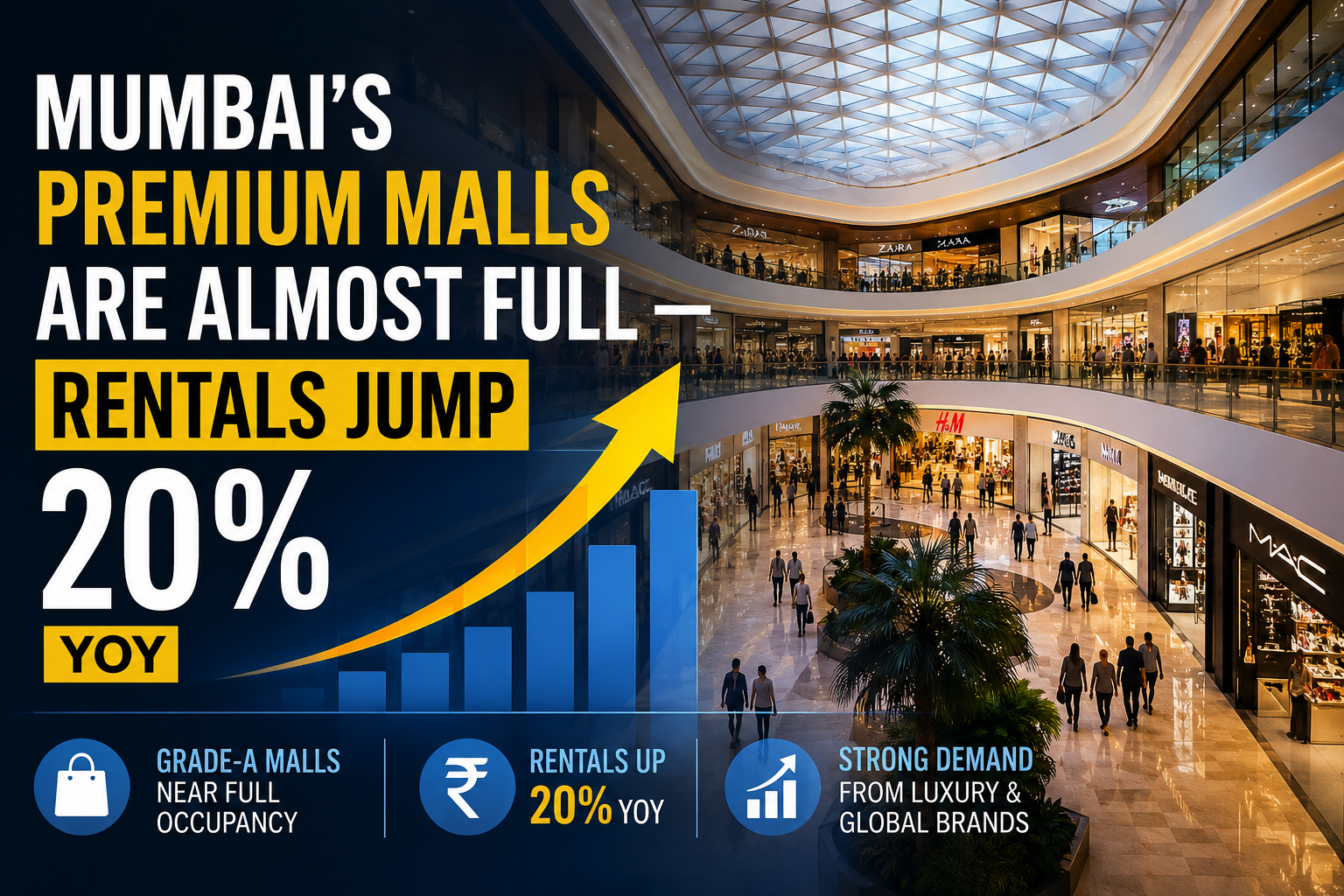
According to a joint analysis by ANAROCK and Images Group, India’s organized retail real estate industry is shifting structurally, with top-tier malls in major cities experiencing record-low vacancies and high rental growth.
According to the survey, Grade A/A+ malls in Delhi-NCR are nearly full capacity, with vacancy rates as low as 0-2%, indicating complete occupancy in top assets. Mumbai, on the other hand, has emerged as the rental growth leader, with mall rentals increasing by 15-20% year on year, suggesting high demand from retailers and limited availability of quality space.
“On a year-on-year basis, Delhi-NCR’s Grade A+ malls have witnessed stronger rental appreciation compared to Grade A assets, indicating a widening gap driven by superior footfalls, tenant productivity, and asset positioning,” said Anuj Kejriwal, CEO – Retail & CEO – EMEA, ANAROCK Group. He stated that this pattern reflects the ongoing “flight-to-quality,” in which premium malls receive a disproportionate share of merchant demand.
The tighter supply environment is being driven by a mix of high consumer demand and aggressive expansion by both global and domestic merchants. “This surge in demand is essentially powered by expansion from international retailers and entertainment anchors,” Kejriwal stated, citing recent transactions involving brands such as Zara, Levi’s, and Foot Locker across key malls in the NCR and Mumbai.
Looking ahead, developers are preparing to meet this demand with a solid supply pipeline. By 2031, Delhi-NCR alone is likely to see approximately 19 million square feet of additional retail space, with over 45 million square feet of new supply projected throughout the top seven cities. “The substantial pipeline planned for Delhi-NCR is a testament to the long-term confidence developers have in the Indian consumer’s appetite for organized retail,” Kejriwal said.
Other metropolitan markets have also demonstrated resiliency. Bengaluru’s occupancy remains high, with vacancy rates ranging between 5-8%, thanks to consistent demand and growth in major corridors. Hyderabad is rising as a supply hub, with over 7 million sq. ft. predicted by 2031, while Pune is experiencing robust leasing activity fueled by major global companies. Meanwhile, rental trends in Chennai and Kolkata remain constant, with relatively minimal new supply.
As city centers become more crowded, a noteworthy trend influencing the sector is a shift toward suburban micro markets. In Mumbai, prospective constructions are more concentrated in Thane, Borivali, and Panvel, while Bengaluru’s growth is spreading to Sarjapur Road, indicating that future retail expansion would be tightly linked to residential growth corridors.
The research also emphasizes the increasing popularity of retail real estate as an institutional asset class. With historically low vacancy rates, stable rental appreciation, and a solid consumption-led demand outlook, the sector is expected to be worth $25-30 billion in investments. Furthermore, the redevelopment potential of 40-50 million square feet in underperforming assets increases the long-term opportunity.
As lease structures evolve and institutional participation grows, India’s retail real estate industry is primed for long-term growth, with Grade A/A+ properties driving the transformation and setting new performance benchmarks by the end of the decade.
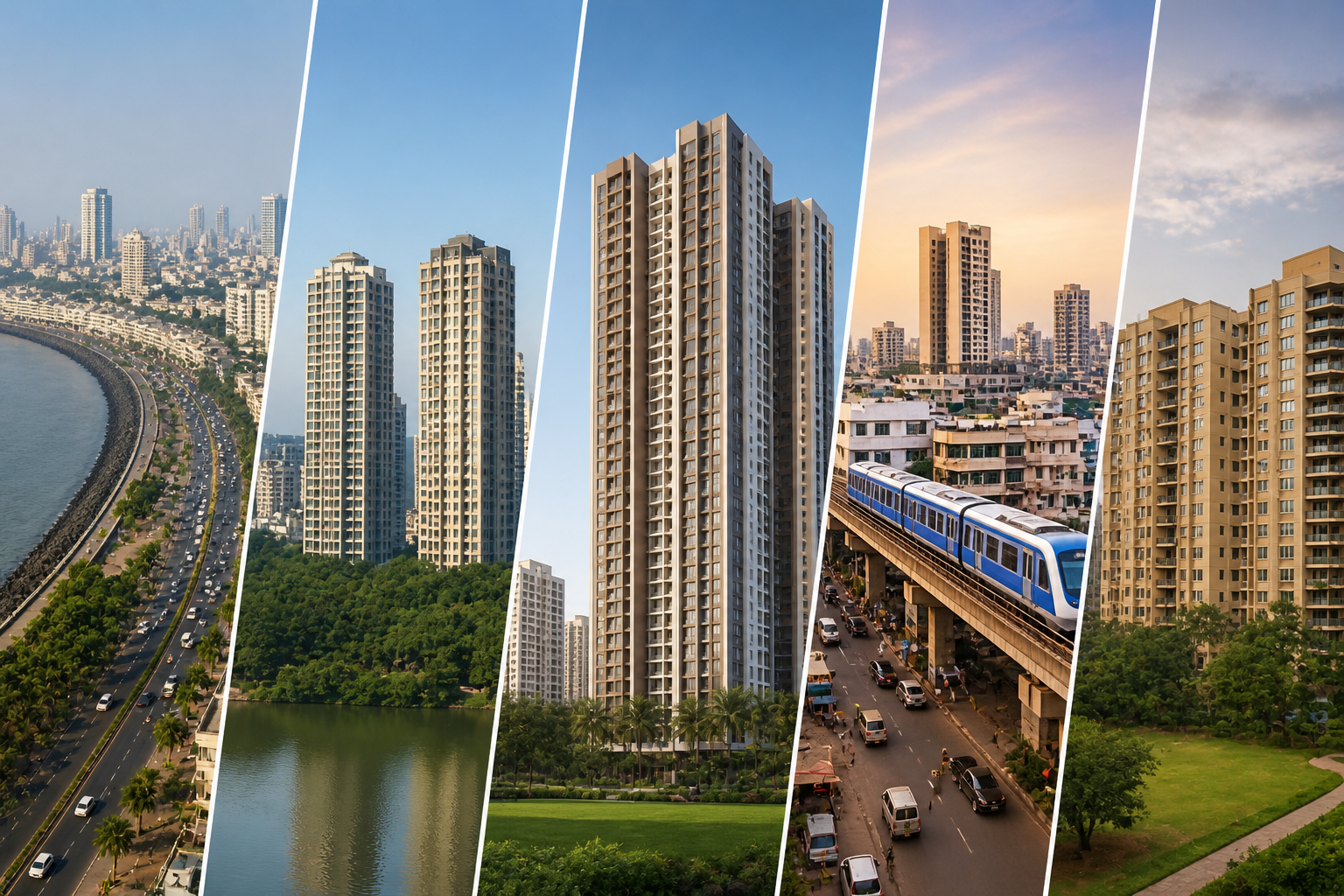
In Mumbai’s real estate market, 1 and 2-BHK apartments continue to be the most popular, accounting for the majority of new launches and transactions. Their attractiveness stems from their practicality; they are affordable to the city’s large buyer base, generate consistent end-user and investor demand, and provide developers with shorter sales cycles.
However, underlying this volume-driven narrative, a quieter transformation has been occurring. In the years following COVID-19, demand switched toward larger 3- and 4-BHK homes, as homebuyers prioritized room, flexibility, and lifestyle improvements. The ultimate effect is a market characterized by dual momentum: small dwellings drive numbers, while larger residences command price power and form the premium end of new supply.
The numbers speak for themselves. According to official estimates, over 42,000 units were registered for launch in Mumbai with the Maharashtra Real Estate Regulatory Authority, with 1 and 2 BHK flats accounting for roughly 55%.
According to MahaRERA data, 25,061 of the 42,643 units launched in 2025 were one- or two-bedroom apartments. In 2025, 2.5 BHK, 3 BHK, 3.5 BHK, and 4 BHK apartments made up 23% of total units, or more than 10,000. In addition, 790 studio flats were launched in 2025.
According to the data, of the 42,643 debuts in 2025, 34% were two-bedroom apartments, 23% were one-bedroom apartments, 19% were three-bedroom flats, and 4% were four-bedroom apartments.
Five places in the Mumbai real estate market where buyers can purchase one-bedroom flats.
1) Dahisar
Dahisar, located on the city’s northern outskirts, is one of the most cheap micromarkets in Mumbai’s real estate market. Local brokers estimate that 1 BHK apartments in Dahisar cost between ₹20,000 and ₹25,000 per sq ft and rent for ₹20,000 to ₹30,000 per month.
2) Borivali-Kandivali belt
The Borivali and Kandivali belts are important micromarkets in Mumbai’s western suburbs. Local brokers estimate that flats in this area cost between ₹30,000 and ₹40,000 per square foot, with monthly rental rates ranging from ₹30,000 to ₹40,000.
3) Mulund
Mulund lies on the eastern edge of the Mumbai real estate market, near to Thane. Local brokers report that prices per square foot range from ₹20,000 to ₹30,000. Rental prices for 1 BHK apartments range from ₹20,000 to ₹35,000.
4) Bandra
Bandra is connected with Bollywood, and many celebrities and actresses have homes there. Several actors own residences in Bandra, including Shah Rukh Khan, Salman Khan, Aamir Khan, Ranbir Kapoor, and Deepika Padukone.
Apartments can cost between ₹70,000 and ₹1 lakh per square foot, according to local brokers. A 1 BHK flat typically costs between ₹60,000 and ₹1 lakh per month to rent.
5) Andheri
Andheri, located in the city’s western suburbs, is regarded central to the Andheri, BKC, and South Mumbai commercial business sectors. It also provides Metro access to the eastern portion of the city and will shortly link to Powai.
Local brokers estimate that apartments in Andheri cost between ₹40,000 and ₹80,000 per square foot, depending on the property. The 1 BHK rental value ranges from ₹40,000 to ₹50,000.

MHADA Flags 82 Mumbai Buildings as ‘Most Dangerous’; Residents Told to Vacate

US-Iran War Pushes Real Estate Construction Costs Up 25%

Mumbai Redevelopment Boom Continues Into 2026

Vijayta Raheja Applauds India’s ₹4 Lakh Crore Urban Vision at ET Maharashtra Business Summit

Mumbai’s Largest MHADA Redevelopment Drive Set to Transform 923 Acres

K Raheja & IHG Team Up to Elevate Powai’s Hospitality Landscape
-
 Real Estate News1 month ago
Vijayta Raheja Applauds India’s ₹4 Lakh Crore Urban Vision at ET Maharashtra Business Summit
-
 Real Estate News2 months ago
Mumbai’s Largest MHADA Redevelopment Drive Set to Transform 923 Acres
-
 New Projects & Launches2 months ago
K Raheja & IHG Team Up to Elevate Powai’s Hospitality Landscape
-

 Real Estate News2 months ago
John Abraham Firm Renews Bandra Rent at ₹12L/Month
-
 Global Real Estate2 months ago
Northfield Sees New Affordable Housing Underway
-
 Global Real Estate2 months ago
Spanish Youth Hostel Group Considers London Real Estate Deals
-

 NRI Real Estate2 months ago
How NRIs Are Driving India’s Property Market?
-

 Real Estate News2 months ago
Lower Parel Sees ₹60Cr+ Luxury Property Boom