

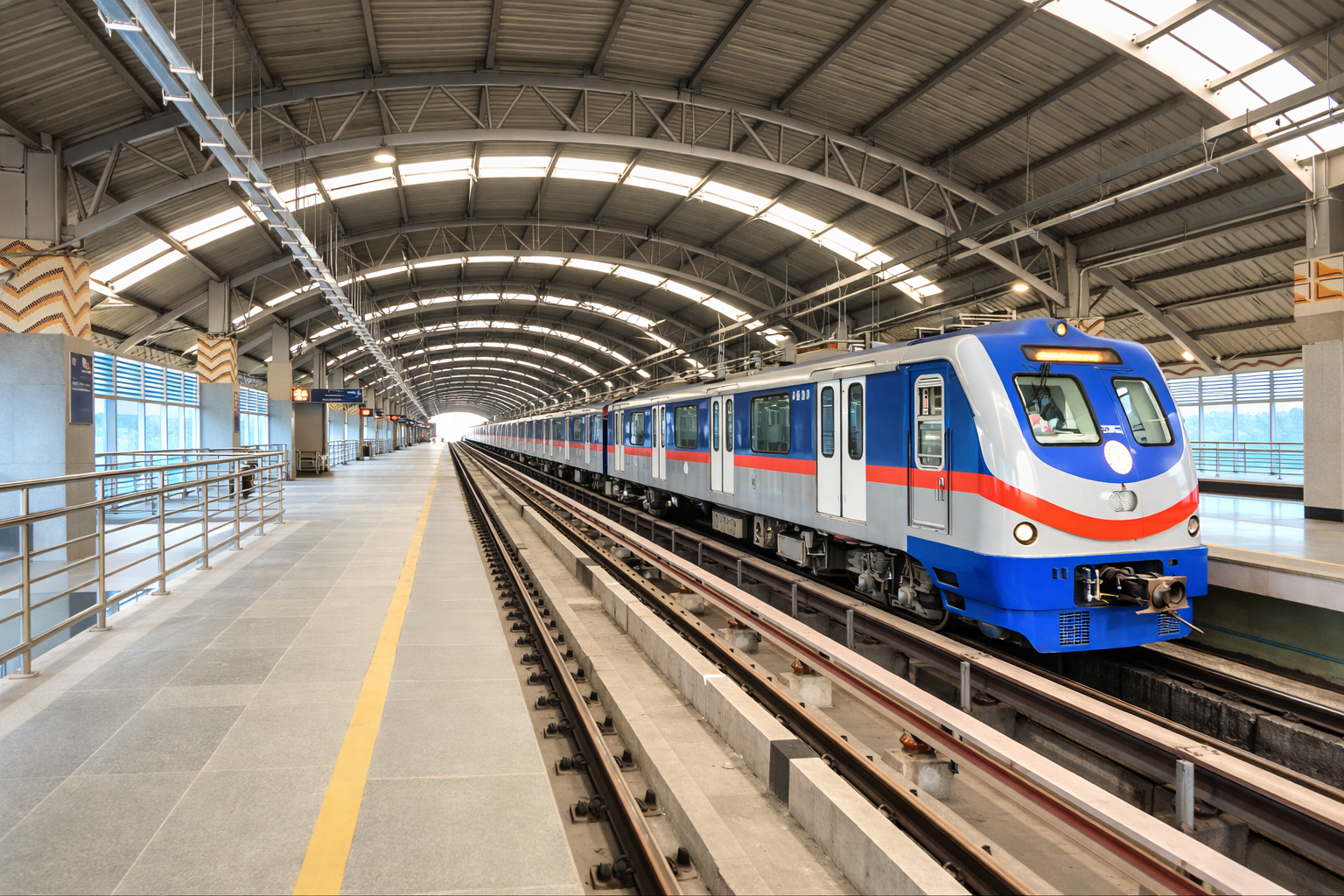
 India's first metro Kolkata Metro Blue Line
Kolkata Metro Line 1 was the country’s first wholly indigenous project, opening in 1984. The establishment of Line 1 was a historic event of great significance. It was created via a trial-and-error technique, with continuous learning and modifications. Let’s take a look at how this line affected the city’s transit system and real estate market.
Table of Contents
The Blue Line, also known as the North-South Metro of the Kolkata Metro Railways, is the country’s oldest operating metro line. It was the first line constructed by the Kolkata Metro Rail Corporation (KMRC). This line was also the first in India to use an automated system for ticket sales and verification. Another notable accomplishment is that this route was India’s first underground railway. This line currently has a daily ridership of approximately 600,000 during the week and 380,000 on weekends.
Stations and interchanges on the Kolkata Metro Blue Line
The Blue Line has 26 stops and stretches 32.25 kilometers. The Blue Line connects seamlessly with other metro routes, offering unprecedented convenience. There are 26 operational stations along the 32-kilometer route between Dakshinwar and Kavi Subhash. There are nine elevated stations, two at-grade stations, and fifteen underground ones.
The Blue Line connects to all of the other lines, including Green, Yellow, Orange, Purple, and Pink. It connects Line 3 (Purple Line) at Esplanade with Line 6 (Orange Line) at Kavi Subhash. It will eventually connect Noapara’s Line 4 (Yellow) with Baranagar’s Line 5 (Pink).
| Station Name | |
|---|---|
| Dakshineswar | Maidan |
| Baranagar (Interchange for Pink Line) | Rabindra Sadan |
| Noapara (Interchange for Yellow Line) | Netaji Bhavan |
| Dum Dum | Jatin Das Park |
| Belgachia | Kalighat |
| Shyambazar | Rabindra Sarobar |
| Shobhabazar Sutanuti | Mahanayak Uttam Kumar |
| Girish Park | Netaji |
| Mahatma Gandhi Road | Masterda Surya Sen |
| Central | Gitanjali |
| Chandni Chowk | Kavi Nazrul |
| Esplanade (Interchange for Purple and Green Line) | Shahid Khudiram |
| Park Street (Interchange for Purple Line) | Kavi Subhash (Interchange for Orange Line) |
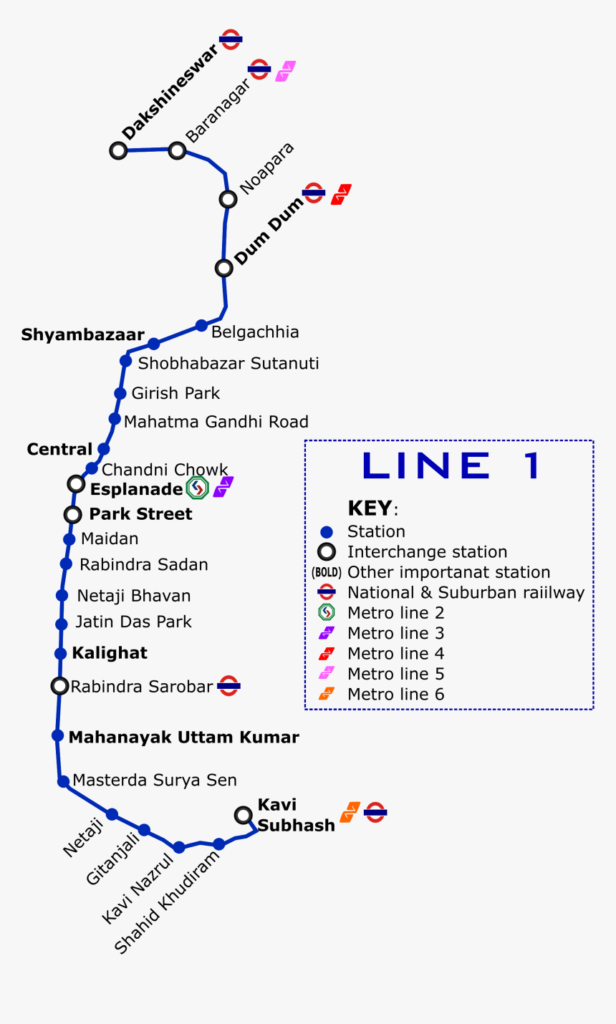
Kolkata Metro Blue Line Route Map
Here’s a route map for the Kolkata Metro Blue Line
The timing and cost for the Kolkata Metro Blue Line
The Kolkata Metro begins operations at 6:50 a.m. from Dumdum, and the last train departs at 10:29 p.m. from Kavi Subhash. The Blue Line Metro runs around every four minutes. Kolkata Metro has the lowest starting fare in India, at Rs 5. Here is a price chart for the Kolkata Metro Blue Line based on distance:
| Zone | Distance (km) | Line 1 (Blue Line) fare |
|---|---|---|
| I | 0-2 | Rs 5 |
| II | 2-5 | Rs 10 |
| III | 5-10 | Rs 15 |
| IV | 10-20 | Rs 20 |
| V | 20-30 | Rs 25 |
Kolkata Metro Blue Line: Key insights and quick facts.
Here are some of the most notable attractions and characteristics of the Kolkata Metro Blue Line.
The manufacturing cost was about Rs 415 crore.
Initially, only four-car trains ran until 1986.
There were no magnetic gates or escalators. Revolving gates served as exits.
Trains ran on a single line.
The 15-kilometer portion between Birpara and Tollygunge took over 23 years to complete.
The last extension of the Kolkata Metro Blue Line took place on February 22, 2021.
Its operational speed is 55 km/h, with a maximum allowable speed of 80 km/h.
Effect on the Real Estate Market
The Kolkata Metro Blue Line has had a considerable impact on real estate, accelerating residential and commercial development. The Kolkata Metro Blue Line has had the following notable affects on the city’s real estate infrastructure:
The demand for homes and businesses has risen around metro stations such as Dum Dum, Belgachia, Shyambazar, Esplanade, and Tollygunge.
Property values along the Blue Line have grown considerably. Buyers pay extra for easy metro access, therefore Sealdah, Tangra, and Entally are more expensive than communities without it.
| Localities | Current Price | Last 1 year | Last 3 years | Last 5 years |
|---|---|---|---|---|
| Sealdah | Rs 9,050/ sq ft | 3.40% | 13.10% | 25.70% |
| Tangra | Rs 10,350/ sq ft | 26.20% | 51.10% | 72.50% |
| Entally | Rs 9,650/ sq ft | 11.50% | 23.70% | 45.10% |
Rental rates for homes and offices have risen. Professionals, students, and businesses gravitate toward metro-connected communities, increasing demand for rentals.
Metro connectivity has converted districts such as Esplanade, Park Street, and Tollygunge into business centers.
To summary, the Kolkata Metro Blue Line has significantly improved city transit and traffic flow since 1984. It has fueled the real estate bubble, boosting demand, property values, and rental rates near metro stations. Business districts have expanded, and infrastructure has improved in the surrounding communities. With its smooth connections to other metro corridors, the Blue Line is important to Kolkata’s prosperity and mobility.




No Comments