Human language is designed to decrease mental effort by employing familiar, predictive patterns based on lived experience.
Human languages are incredibly intricate systems. There are around 7,000 languages spoken around the world, ranging from those with few remaining speakers to extensively utilized languages such as Chinese, English, Spanish, and Hindi, which are spoken by billions of people.
Regardless of their various distinctions, all languages serve the same fundamental goal. They express meaning by combining individual words into phrases, which are subsequently organized into sentences. Each level has its own significance, and when combined, they allow people to communicate in a clear and understandable manner.
Why is language not digitally compressed?
“This is a very complex structure.” Since the natural world seeks to maximize efficiency and conserve resources, it’s totally legitimate to wonder why the brain records linguistic information in such an obviously difficult method rather than digitally, as a computer,” explains Michael Hahn.
Hahn, a Professor of Computational Linguistics at Saarland University, has been investigating this subject with his colleague Richard Futrell of the University of California, Irvine. In principle, storing information as a simple binary sequence of ones and zeros would be significantly more efficient because it allows for greater compression than natural language. This prompts an obvious inquiry. Why don’t humans communicate figuratively, like R2-D2 from Star Wars, but instead use spoken language? Hahn and Futrell have now found an answer.
“Human language is shaped by the realities of life around us,” Hahn points out. “For example, if I used the abstract term ‘gol’ to describe half a cat and half a dog, no one would understand what I meant because no one has ever seen a gol.” It just does not reflect anyone’s personal experiences. Similarly, it makes no sense to combine the words ‘cat’ and ‘dog’ into a string of characters that has the same letters but is impossible to decipher,” he says. Even though “gadcot” has the letters from both words, it is meaningless to us. In contrast, the phrase “cat and dog” is immediately intelligible because both terms refer to well-known animals.
Familiar structure reduces cognitive work.
Hahn explains the study’s main findings as follows: ‘Put simply, it is easier for our brain to pursue what appears to be the more convoluted path.’
Although the information is not in the most compact form, the computational load on the brain is much reduced since the human brain processes language in constant interaction with its familiar natural surroundings. Coding the information in solely binary digital form may appear more efficient because the information can be delivered in less time, yet such a coding is disconnected from our real-world experience.
According to Michael Hahn, the everyday commute to work serves as an excellent analogy: “On our usual commute, the route is so familiar to us that the drive is almost like on autopilot.” Our brain knows exactly what to expect, therefore the effort required is significantly smaller. Taking a shorter but less familiar route feels considerably more taxing, because the new route requires us to be far more attention while driving. Mathematically, ‘the number of bits the brain needs to process is significantly fewer when we speak in familiar, natural ways.’
Prediction influences how sentences are understood.
Encoding and decoding information digitally would necessitate substantially more cognitive work from both the speaker and the listener. Instead, the human brain constantly assesses the odds of words and phrases occurring in sequence, and because we speak our native language on a regular basis for tens of thousands of days during our lives, these sequence patterns become deeply ingrained, further lowering computational load.
Hahn provides another example: ‘When I pronounce the German phrase “Die fünf grünen Autos” (Engl.: “the five green cars”), the phrase will almost likely make sense to another German speaker, whereas “Grünen fünf die Autos” (Engl.: “green five the cars”) won’t,’ he adds.
Consider what happens when a speaker says, ‘Die fünf grünen Autos’. It starts with the German definite article ‘Die’. At that moment, a German-speaking listener will be aware that the word ‘Die’ is likely to indicate a feminine single noun or a plural noun of any gender. This permits the brain to immediately rule out masculine and neuter singular words.
The following word, ‘fünf’, is most likely to refer to something countable, ruling out non-enumerable ideas like ‘love’ or ‘thirst’. The next word in the sequence, ‘grünen’, informs the listener that the yet-unknown noun will be plural and green in colour. It could be cars, bananas, or frogs. Only when the final word in the ‘Autos’ sequence is said does the brain resolve the remaining uncertainty. As the phrase progresses, the number of interpretative choices decreases until (in most situations) only one final meaning remains.
However, in the phrase ‘Grünen fünf die Autos’ (English: ‘green five the vehicles’), this logical chain of predictions and correlations fails. Our brain is unable to derive meaning from the sentence because the normal sequence of cues is broken.
Implications of artificial intelligence
Michael Hahn and his colleague Richard Futrell from the United States have mathematically established these correlations. Their study’s significance is shown by its publication in the high-impact journal Nature Human Behaviour. Their findings could be useful in the continued development of large language models (LLMs), which underpin generative AI systems like ChatGPT and Microsoft’s Copilot.




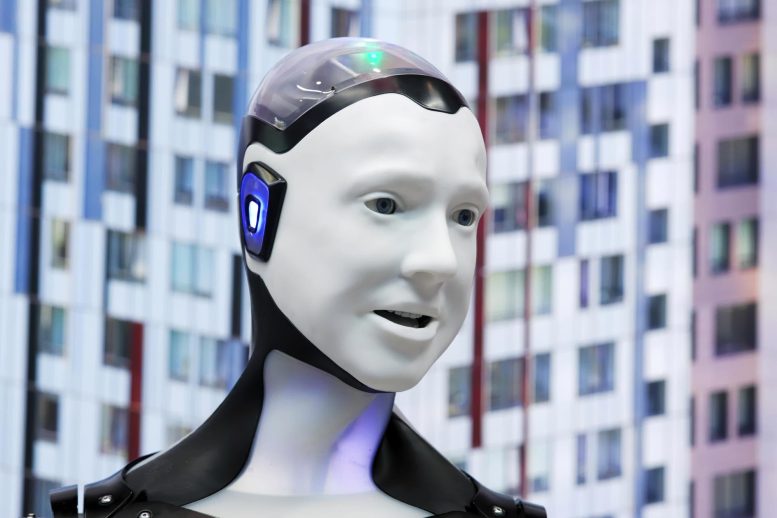 Why We Don't Talk Like Computers: Scientists Finally Have an Answer






No Comments