Ukraine will receive up to 100 Rafale F4 fighter jets from France, as well as advanced air defence systems, as part of a huge agreement to strengthen Kyiv’s ability to defend itself against devastating Russian strikes.
Ukrainian President Volodymyr Zelensky described the move as “historic” after signing a letter of intent with French President Emmanuel Macron at an aviation base near Paris.
Deliveries of Rafale F4s are expected to be completed by 2035, while cooperative manufacture of interceptor drones begins this year.
Financial details have still to be worked out, but sources suggest France intends to seek EU money as well as access to Russian assets, a contentious step that has split the 27-member bloc.
“This is a strategic agreement that will last for ten years beginning next year,” Zelensky said during a joint conference with Macron on Monday.
Ukraine would also receive “very strong French radars,” eight air defence systems, and other advanced weapons, he said.
Zelensky emphasised that using such powerful technology “means protecting someone’s life… this is very important”.
In recent months, Russia has expanded its drone and missile strikes on Ukraine, targeting electricity and rail infrastructure and creating widespread blackouts.
Dozens of civilians have been killed in the strikes, which Kyiv and its Western backers regard as war crimes. Three people were killed and 15 injured in the latest Russian missile attack overnight in the north-east Ukrainian city of Balakliya, according to local officials.
Speaking alongside Zelensky, Macron stated: “We’re planning Rafales, 100 Rafales – that’s tremendous. That is what is required to regenerate the Ukrainian military.”
The French president went on to say that he wanted to help Ukraine prepare for whatever comes next.
These Rafale fighter jets are viewed as critical to Ukraine’s air defence, as the country is almost helpless to prevent long-range air raids on its border towns and cities.
“The Russians are using 6000 glide bombs per month,” Serhiy Kuzhan, a Ukrainian security analyst, “It would be important to have a French air to air system, with a 200km range, because Russians have their own system with a range of 230km.”
While this announcement between Kyiv and Paris is significant, Justin Bronk of the Royal United Services Institute (RUSI) points out that “the difference they’ll make will depend on the timeframe and the missiles that come with them”.
Because this is a long-term political agreement rather than a precise purchase order, few anticipate the news to significantly alter the dynamics of Russia’s ongoing invasion.
The promises of Western military weapons are only as effective as the training and logistics that accompany them. Whether it’s a German-built Leopard 2 Tank or an American F16 fighter jet, they all require extensive training, large support staff, and an abundance of spare parts.
The Rafales complicate the question of who pays. France is expected to use its own budget allocations for Kyiv, as well as shared EU borrowing instruments, to help fund the accord.
However, private admissions in the EU’s corridors of power in Brussels indicate that the money is running out.
The union has agreed to help support Ukraine’s devastated economy for the next two years, but there is less agreement on whether to unlock €140 billion ($162 billion; £123 billion) in frozen Russian assets to assist Ukraine financially and militarily.
The measures are now unlawful under international law, and several members are concerned about having to repay Russia after the conflict.
Ukraine’s air force already employs French Mirage fighters as well as US-built F-16s. Kyiv has also lately tentatively agreed to purchase Sweden’s Gripen fighter fighters.
Following France, Zelensky will head to Spain to seek additional military and other support for Ukraine.
Over the weekend, he signed a gas deal with Greece. Vital supplies of US liquefied natural gas are anticipated to start pouring into Ukraine this winter via a Balkan pipeline.
Russian President Vladimir Putin started a full-fledged invasion of Ukraine in February 2022.
Moscow presently controls approximately 20% of Ukraine’s territory, and Russian troops have been making sluggish progress along the broad front line, despite reported high battle deaths.


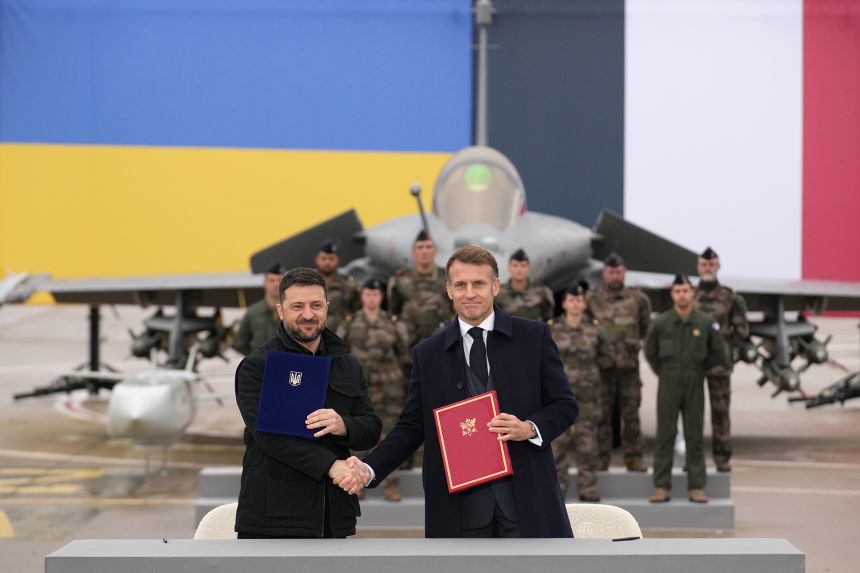 Ukraine to get up to 100 French-made Rafale fighter jets




No Comments