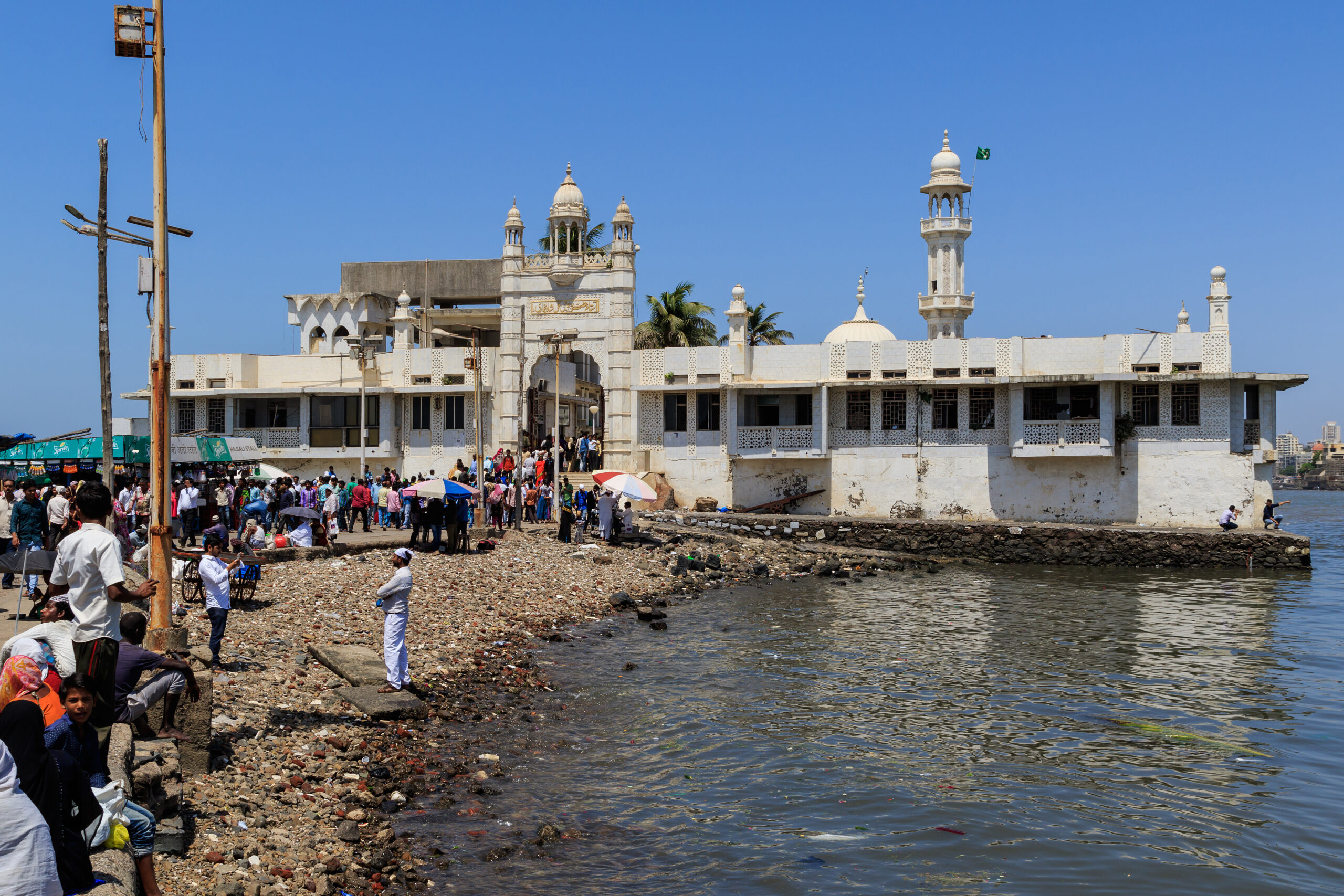
Haji Ali Dargah, one of the most well-known Islamic shrines, exemplifies the Indo-Islamic architectural style. The Haji Ali Dargah is well-known for its stunning setting, architectural beauty, and religious significance. It houses the mortal remains of Pir Haji Ali Shah Bukhari, a 15th-century Sufi saint. The mosque, set against the stunning Arabian Sea, looks to be floating on water. Haji Ali Dargah, one of the top locations to visit near Mumbai, located around 6 kilometers from Mumbai’s Chhatrapati Shivaji Terminus. Here’s everything you need to know about the Haji Ali Dargah in Mumbai, including its architecture, history, and opening hours.
Haji Ali Dargah – Architecture
This beautiful Dargah in Mumbai, spread over 4,500 square meters and 85 feet in height, is created with ‘Makrana’ marble, the same marble used in the Taj Mahal structure. The shrine houses two monuments: a mosque and Pir Haji Ali Shah Bukhari’s mausoleum. The monument is ringed by eight marble pillars and coated in silver frames on all sides. The structural design of Mumbai’s iconic Dargah reflects Indo-Islamic and Mughal architectural influences. Due to its unusual and stunning location, the road to the mosque becomes buried in water during high tide, rendering it inaccessible.
The main hall of the Haji Ali Dargah is surrounded on three sides by three halls: south, west, and east. While the west hall is restricted for ladies, men may pray in the east hall. The marble ceiling of the center hall is embellished with mirror work and etched with 99 distinct names of Allah. In addition, the main hall’s walls and ceilings are inscribed with Quran Sharief phrases. The mosque also has a three-story sanatorium and a separate Qawwal Khana. The Haji Ali Masjid is connected to the seaside by a 700-yard boardwalk. There are no railings on either side of the pavement, so tourists are thrilled when the sea’s waves crash against the pathway. At night, the mosque lights up in the distance, surrounded by nothing but the majestic Arabian Sea, creating a heavenly scene. It appears to be floating in the water, with no tie to the mainland.
Haji Ali Dargah – History
Sayyed Pir Haji Ali Shah Bukhari, a 15th-century Sufi saint, founded Mumbai’s famed Dargah. He was a wealthy businessman from Bukhara, located in modern-day Uzbekistan. Just before departing for Mecca, he made the decision to give up all of his earthly wealth and worldly things in order to become a saint. Later, he traveled the world and eventually settled in Mumbai, A mystical legend of Haji Ali Dargah states that the Sayyed Peer once came upon a destitute lady crying on the road while holding an empty pot. The lady used to sell oil, but one day she unintentionally split it on the road. Haji Ali returned to the same area, jabbing his fingers into the ground. The oil oozed from the dirt, and the lady refilled the vessel before thanking the saint.However, the saint had a troubling dream that night, believing that his actions had harmed the earth. He was filled with regression and grief, which damaged his health as well. Later, he traveled to India and arrived at the Mumbai beach. He wanted to remain in Mumbai permanently and raise Islam awareness over the world.
However, the saint had a troubling dream that night, believing that his actions had harmed the earth. He was filled with regression and grief, which damaged his health as well. Later, he traveled to India and arrived at the Mumbai beach. He wanted to remain in Mumbai permanently and raise Islam awareness over the world.
Another historical fact is that Haji Ali Dargah is related with the Saint’s death. It is reported that he instructed his disciples not to bury him straight away after his death, but rather to dump the casket into the water and later bury the body in the precise location where it was found. The saint’s devotees did the same, and his coffin was discovered on a mound near Worli. The Haji Ali Masjid and the saint’s tomb were later built on the same site. Today, the tomb has become a well-known mosque where people of various faiths visit to seek blessings.
Haji Ali Dargah- Timings
Haji Ali Dargah is open every day of the year, from 5:30 a.m. until 10:00 p.m. However, the greatest time to see this lovely mosque is between October and March, when tides are lower and easier to approach. This mosque receives approximately 40,000 visits every day, with Thursdays and Fridays being particularly busy. You can also visit this Dargah to participate in the ceremonies of Islamic festivals such as Ramzan and Eid. Aside from that, the yearly Urs, or death anniversary of Sayyed Pir, is the most significant event here. Remember that this famous Dargah in Mumbai can be reached during low tides via a walkway surrounded by sea on all sides.
How to Reach Haji Ali Dargah
Visitors can access the Dargah by taking busses or taxis to Worli Bay and then walking up to the mosque.
Via Air – The Dargah is about 20 kilometers from the Mumbai airport.
Via Sea – The Haji Ali Dargah, located near the Worli Sea Link, is accessible by any water transportation option or taxi.
The mosque is well-connected by train. So you can go there from Mumbai Central, Byculla, and Mahalaxmi Stations.
Tourist Attractions near Haji Ali Dargah in Mumbai
Marine Drive
Marine Drive, also known as Netaji Subhash Chandra Bose Road, is considered the pride of Mumbai, the City of Dreams. This stunning location, 5.2 kilometers from Haji Ali Dargah, is also known as the Queen’s Necklace because streetlights along the vast shoreline resemble a necklace of glittering pearls, producing a virtual impression of a necklace. You can visit this location to enjoy the natural beauty, take stunning photos, and eat some local specialties.
Siddhi Vinayak Temple
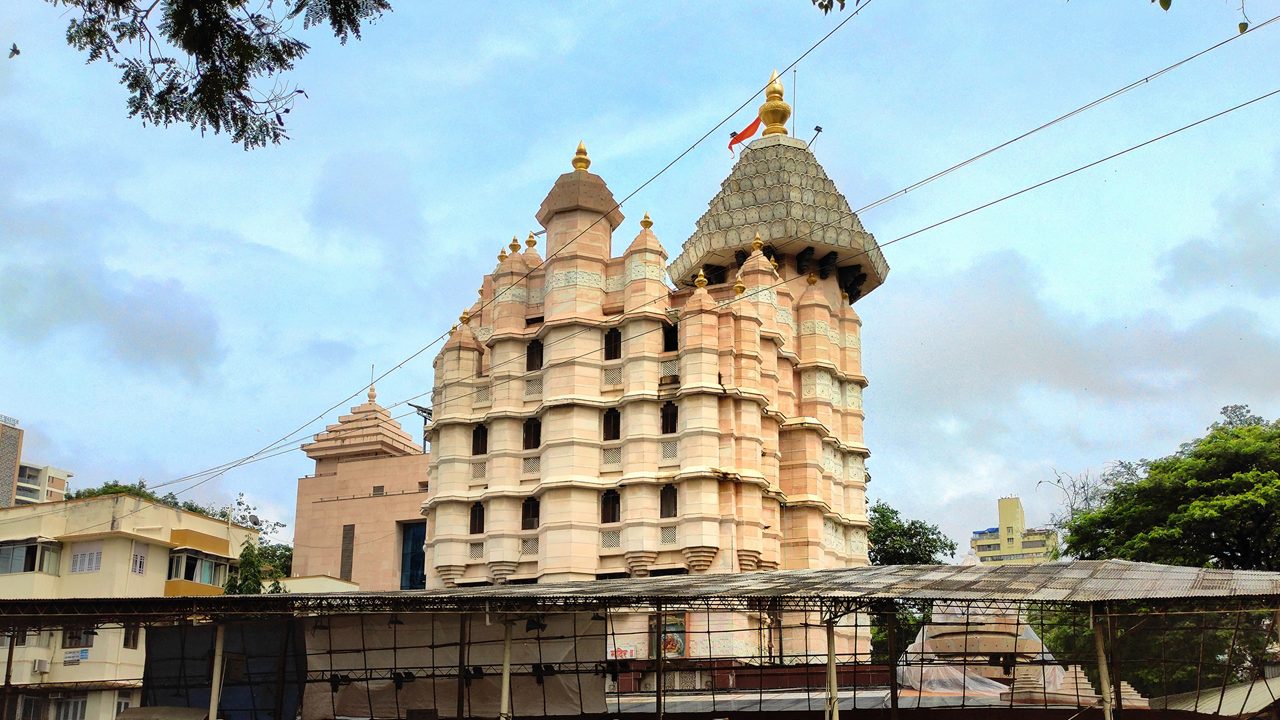
The Siddhi Vinayak temple, located 6.2 kilometers from Haji Ali, is a highly renowned sanctuary dedicated to Lord Ganesh. The temple has a modest sanctum with the idol of Shri Ganesha, which is constructed from a single piece of black stone. It is claimed that the Lord Ganesha statue manifests itself and fulfills followers’ wishes.
Nehru Planetarium
The Nehru Planetarium, which is part of the Nehru Centre, is well-known for its astronomical and scientific educational programs. The Planetarium was designed by architect J M Kadri and features a cylindrical construction with a spectacular dome. The Nehru Planetarium, located 2.5 kilometers from the Haji Ali Mosque, includes some sets that allow visitors to witness astronomical occurrences such as eclipses. So, if you are interested in science and space, don’t miss the Nehru Planetarium in Mumbai.
Chowpatty Beach
Chowpatty Beach, one of Mumbai’s most popular tourist attractions, is located approximately 3.4 kilometers from the Haji Ali Dargah. Watching the magnificent sunsets is an experience worth having at least once in a lifetime. You can also enjoy various recreational activities such as a camel ride, merry-go-round, ferris wheels, and pony rides. This Mumbai tourist destination is well-known for its stalls selling mouthwatering Bhel-Puri, as well as other delightful selections such as Pav Bhaji, Chat, Pani Puri, Golas, and Kulfi.
Elephanta Caves
The Elephanta Caves, also known as Gharapurichi Leni, are located on Elephanta Island in Mumbai. The Elephanta Caves, designated as a UNESCO World Heritage Site in 1987, are the pinnacle of Indian architecture, with Indian mythology represented in every corner. The cave temple complex spans 60000 square feet and houses the major chamber, courtyards, and various minor shrines. When visiting Mumbai, be sure to add the Elephanta Caves in your itinerary to experience the spiritual and historical marvels.
In addition, you can visit the Chhatrapati Shivaji Maharaj Vastu Sangrahalaya, Worli Fort, Jehangir Art Gallery, Colaba Causeway, and Gateway of India.


 Haji Ali Dargah in Mumbai: History, Timings, and Location



No Comments