Economic reforms in India relate to the neoliberal measures undertaken by the Narsimha-Rao government in 1991, during India’s acute economic crisis caused by external debt.
It discusses industrial and labour policies, monetary and fiscal policy, privatisation, and the role of economic planning.
The following is a summary of the subjects covered above. When studying, make sure to completely cover these topics.
Economic reforms in India relate to the neoliberal measures undertaken by the Narsimha-Rao government in 1991, during India’s acute economic crisis caused by external debt. The government’s revenues were insufficient to fund expenses. As a result, it was compelled to borrow extensively from international institutions to pay off its debt.
Liberalization:
Liberalisation was designed with the premise that any laws or barriers on free trade needed to be relaxed in order for trade to occur. It facilitated the opening of economic frontiers to foreign investment and multinational corporations. Several economic reforms were implemented as part of the Liberalisation process, including increased production capacity, de-servicing of producing areas, the elimination of government industrial licensing, and the freedom to import commodities.
Privatization:
Privatisation is giving the private sector more control over certain services while reducing the role of the public sector (government-owned firms) in them. FDI (Foreign Direct Investment) was introduced in India through privatisation, resulting in robust competition for Indian goods and services.
Globalization:
Globalisation refers to the integration of the Indian economy with the global economy through economic reforms. It implies that India’s economy would henceforth be reliant on the global economy, and vice versa. It fosters foreign direct investment and trade with a variety of countries.
Features of the New Economy in India
Economic reforms are policy changes designed to improve a country’s economic efficiency. Economic reforms are primarily required to resolve distortions produced by international regulations or government policies. Economic reforms occur when the government is deregulated or reduced in size. It is also performed by eliminating or minimising market distortions in specific sectors of the economy.
Economic reforms involve adjustments to broad-based policies like taxation and competition. These measures aim to improve economic efficiency rather than eliminate other issues like unemployment or equity growth.
During the reform period, the service sector grew, while agriculture contracted and the industrial sector fluctuated.
The openness of the Indian economy led to a huge growth in FDI and foreign exchange reserves.
This category of foreign investment includes both foreign institutional and direct investment.
During the reform period, India was a successful exporter of engineering items, automobile parts, computer software, and textiles, Price hikes were also held in check during the reforms.
Agriculture was ignored, and state investment was cut, damaging infrastructure.
Fertiliser subsidies were discontinued, raising production costs for many marginal and small farmers.
Furthermore, several policies were implemented to minimise agricultural import taxes, lower the minimum support price, and enhance the danger of multinational groups competing with local farmers.
The industrial sector expanded in an uneven manner.
Demand for industrial items fell as imports became more affordable.
Globalisation, which enabled free commerce between countries, had a severe influence on local sectors and, consequently, job possibilities.
Economic colonialism has grown as a result of the reforms.
It also led to the decline of culture.
Many infrastructure investments, including power supply, were insufficient.
Objectives of the New Economic Policy
The NEP’s purpose was to cut inflation and build up adequate foreign currency reserves to increase the country’s economic growth rate.
The primary purpose is to pull the Indian economy into the ‘globalisation’ arena and give it a new market direction.
It aimed to achieve economic stability and a market economy by eliminating all extraneous rules.
It called on private actors from all areas of the economy to get more involved. As a result, the number of individuals employed in the reserved government sector has reduced.
It aspired to allow for the free flow of goods, services, capital, human resources, and technology across borders.
Conclusion
The RBI Grade B Phase II exam’s ESI portion covers India’s economic reforms. It discusses industrial and labour policies, monetary and fiscal policy, privatisation, and the role of economic planning. Economic reforms in India relate to the neoliberal measures undertaken by the Narsimha-Rao government in 1991, during India’s acute economic crisis caused by external debt. It facilitated the opening of economic frontiers to foreign investment and multinational corporations. Several economic reforms were implemented as part of the Liberalisation process, including increased production capacity, de-servicing of producing areas, the elimination of government industrial licensing, and the freedom to import commodities.




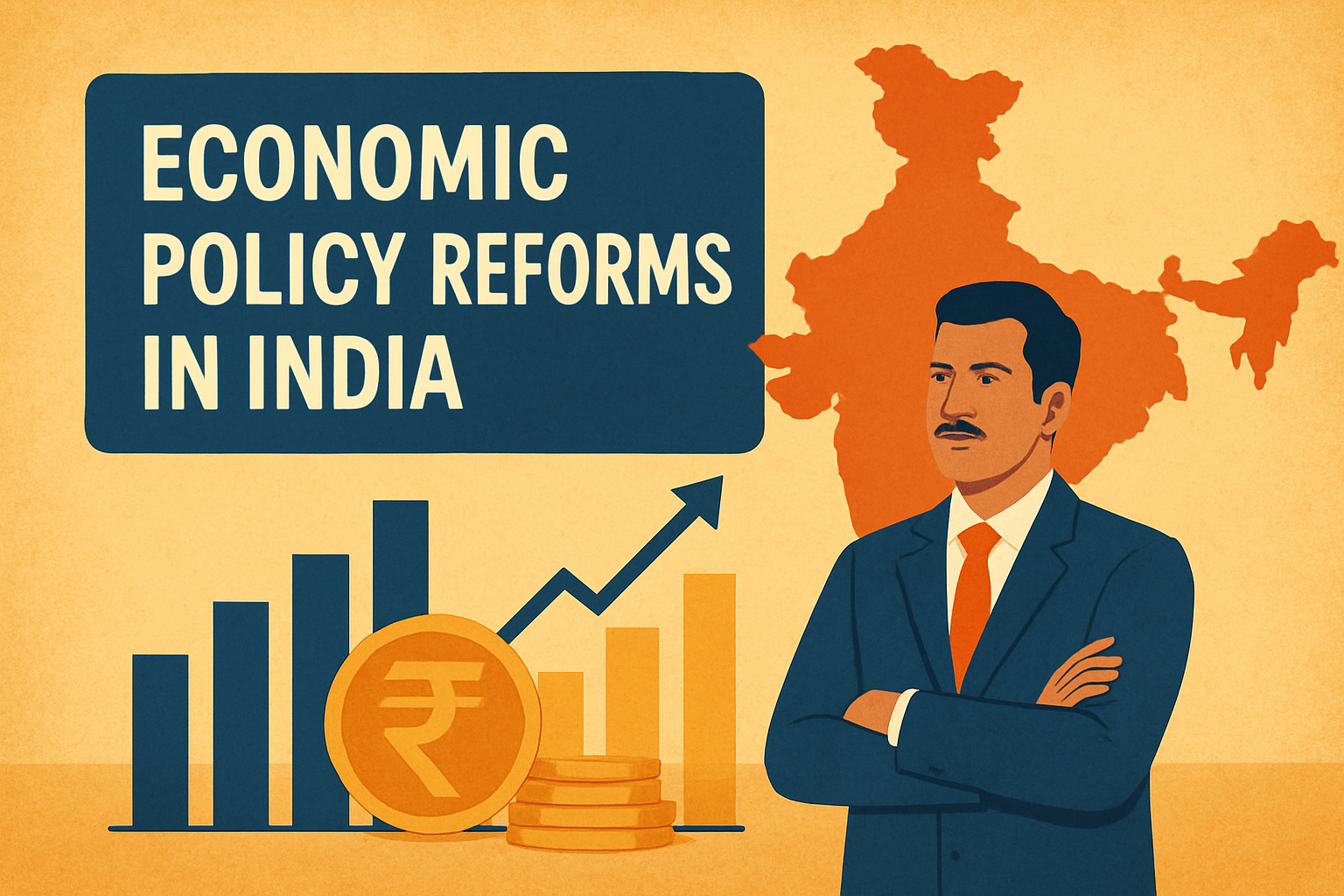 Economic Policy Reforms in India







No Comments