The quest for life-supporting worlds in the Solar System includes the Jovian moon Europa. Yes, it’s an iceberg of a world, but beneath its frozen surface is a deep, salty ocean and a nickel-iron core. It is heated by tidal flexing, which exerts pressure on the interior ocean, causing water and salts to rise. As it turns out, there is also evidence of ammonia-containing molecules on the surface. All of this adds up to an interesting study at Europa’s geology and potential as a life-sustaining environment.
Data from the Galileo spacecraft, which orbited the Jupiter system from 1995 to 2003, hinted at the presence of such ammonia compounds, but they were only discovered recently. NASA/JPL scientist Al Emran examined observations taken by the Near-Infrared Mapping Spectrometer. He discovered faint ammonia absorption bands at 2.2 microns near fissures in the Europan surface. These gaps serve as the primary channels for liquid water to ascend from deep underground, a type of eruptive activity known as cryovolcanism.
That water most likely carried ammonia, which deposited on the surface. Because ammonia can not survive long in space, the ammonia identified by Galileo’s probe was excavated and deposited very recently in geological terms. It also indicates that the presence of ammonia has altered the chemistry of the ocean. The existence of nitrogen (via ammonia) has astrobiological ramifications.
A cross-section of what scientists believe lies beneath the cold Europan crust. A saltwater ocean covers a rocky core and holds twice as much water as all of Earth’s oceans. Tidal flexing heats the interior, which may help make this a suitable habitat for life to grow. NASA/JPL-Caltech.
Ammonia, Cryovolcanism, and Life
The chemical formula for ammonia is NH3, which is a combination of nitrogen and hydrogen. Nitrogen is an essential component of life, as it helps to produce amino acids, DNA, chlorophyll, and proteins. On Earth, some bacteria transform atmospheric nitrogen gas (N2) into ammonia, which many living creatures require for growth. The presence of ammonia and nitrogen does not necessarily imply that life exists on Europa, but it does suggest a suitable climate. It also provides information about the geological activity on the moon.
Europa is not the only location where NH3-containing chemicals have been discovered in the Solar System. Pluto, Charon, Nyx, Hydra, as well as the Uranian moons Ariel, Miranda, Umbriel, Oberon, and Titania, all have significant amounts of it. It can also be found in the plumes that rise from Enceladus’s deep ocean. Other locations have suggested the potential presence of ammonia compounds. So it isn’t a rare find. However, detecting it has been difficult since the signals become buried in detections of other compounds. The discovery on Europa confirms the pervasive existence of ammonia. Ammonia has a geological effect on the features of an ocean’s water. Among other things, this chemical significantly reduces water’s freezing point. As water ice forms on Europa’s surface, ammonia concentrations increase.
Europa is a Busy World
JWST observations of Europa’s surface suggest that the topography has recently been altered by ongoing cryovolcanic activity. In a few weeks, water brought to the top and frozen in place will begin to be pushed away by intense particle activity, leaving deposits of ammonia and other chemicals. In the re-analysis of Galileo data, Emran’s observation of a 2.2-micron absorption characteristic revealed the existence of NH3-hydrate (ammonia dissolved in water) and NH4-chloride (a water-soluble salt crystal). The existence of these and other chemicals suggests that Europa has experienced substantial geological activity (within the last million years).
Finding ammonia compounds on this moon advances the science planned for NASA’s Europa Clipper. That mission launched on October 14, 2024, and will arrive in the Jupiter system by 2030. One of its primary goals is to discover whether Europa has any livable conditions beneath its ice surface. The fact that it contains a liquid ocean and potential organic chemical deposits will provide the Clipper’s instruments with an up-close and personal opportunity to search for the building blocks of life.
In addition to conducting chemical analyses of the deep ocean, Europa Clipper will assess the thickness of the Europan surface, investigate how the ocean interacts with the shell, and learn more about the moon’s geological composition. Project scientists are particularly interested in understanding surface features and how they are shaped. As the Clipper approaches Jupiter, ongoing re-examinations of Galileo and other data should assist Clipper scientists fine-tune the mission and its scientific goals.




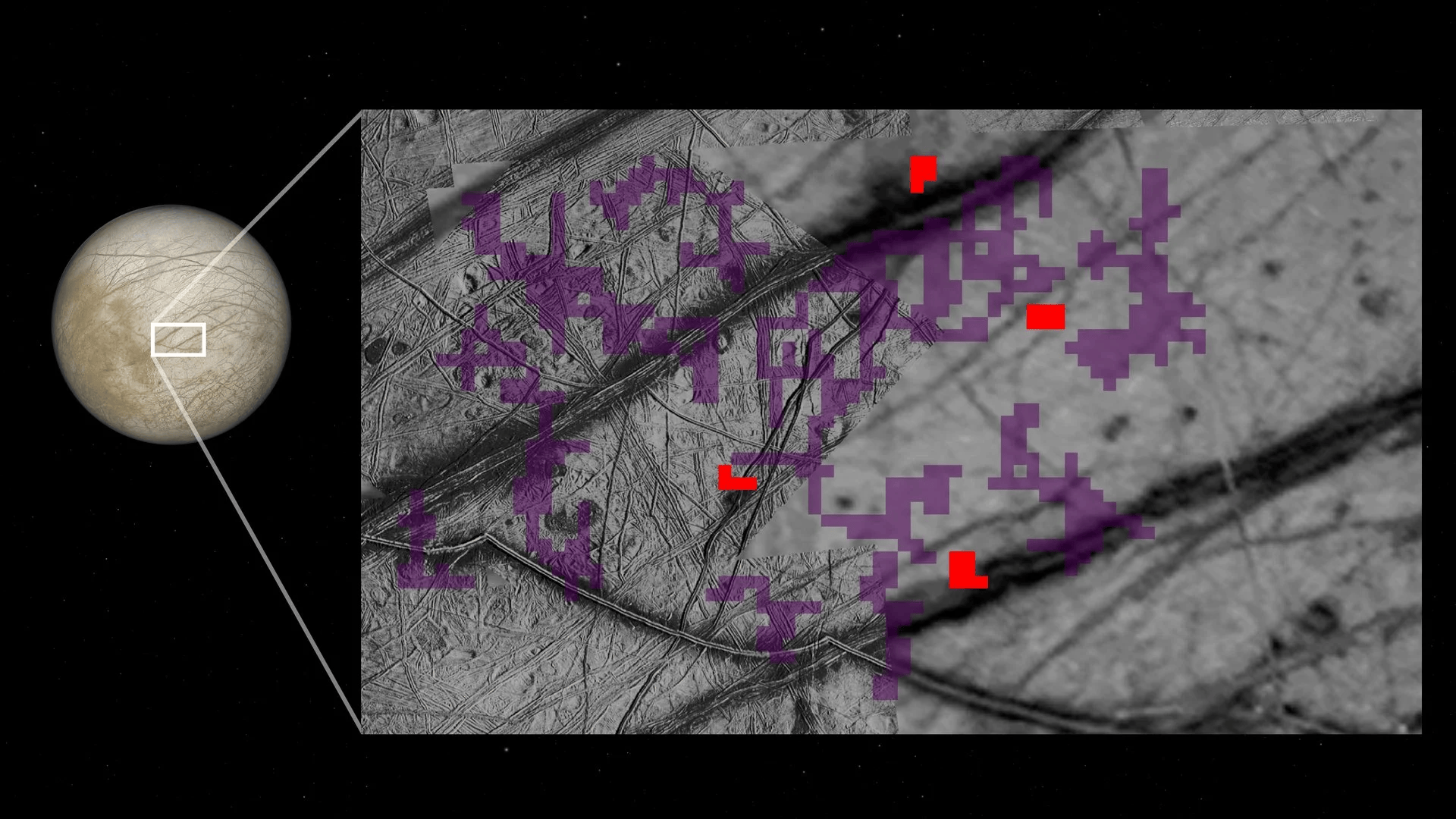 Cracks on Europa Sport Traces of Ammonia




No Comments