Amritsar is essentially a distilled version of Punjab. If you don’t have time to visit all of Punjab, Amritsar will suffice. The classic Punjabi characteristics, such as rich spicy food, friendly hospitality, and spiritual sentiments inspired by Sikhism, are all there in abundance. However, Amritsar is most recognized around the world for its spectacular Golden Temple, also known as Gurudwara Harmandir Sahib. However, Amritsar has a lot more to offer.
Sikhs live by three guiding principles: truthfulness, service to humanity, and devotion to God. It is difficult to evaluate a community in terms of ‘truthful living’ and ‘devotion to God’. However, if you visit Amritsar, you would have no doubts regarding the Sikh approach of’service to humanity’.
If one is close to a Gurudwara, free food is never far away. Food is not only available in the Gurudwara. Punjabis and Sikhs enjoy both eating and feeding people. You would never met more helpful and welcoming individuals anywhere else in the globe. They enjoy eating, dancing, and having fun, regardless of what life throws at them.
Amritsar is a reflection of the warm-hearted Punjabis. Amritsar is a joyous occasion, a celebration of life.
A brief history of Amritsar and Golden Temple:
Prior to 1574, the region now occupied by the city of Amritsar was covered in forest and water. Guru Amar Das, the third Guru of Sikhism, picked this location for the Sikhs (learners) to reside. In 1577, on his directions, the fourth Guru, Ram Das, excavated a pond and built a Guru Center nearby. People began naming it Ramdaspur, referring to the Guru’s name.
The place gradually became known as Amritsar; ‘Amrit’ means nectar, while ‘Sar’ is a short form of ‘Sarovar’, which means pool. Thus, Amritsar literally means “pool of nectar.”
Some people claim that Guru Ram Das ordered the construction of Harmandir Sahib. Some believe that Guru Amar Das’ son built the temple in the midst of the pool (Amrit-Sarovar) in 1604. Later, Guru Arjan Dev (fifth Guru) placed the Guru Granth Sahib (Sikh religious scripture) inside it.
Despite these differences, most people credit Guru Arjan Dev with the creation of Harmandir Sahib. Interestingly, the foundation was set by Mian Mir, a Sufi saint from Lahore. Harmandir Sahib was given the moniker Golden Temple in 1830, when Raja Ranjit Singh covered the shrine in gold leaf.
Tumultus Times!
Throughout history, the Golden Temple and Amritsar have been the target of various invading armies. The Mughals assaulted Amritsar multiple times in the 17th and 18th centuries, but the Afghans attacked it in 1757. Later, in the post-independence era, it became the focal point of a violent political campaign that culminated in Operation Bluestar.
Each time, the Golden Temple bore the brunt of the fighting. However, each time, the Sikhs restored the Golden Temple to its previous beauty.
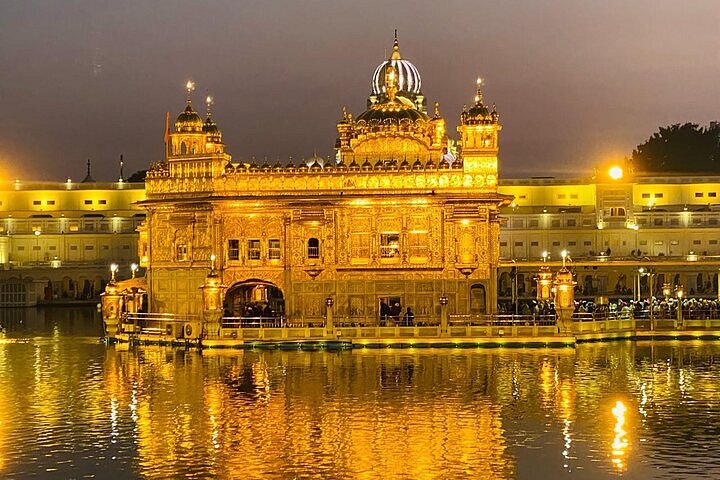
However, after some rest, we were able to visit the Golden Temple and Jallianwala Bagh. After paying our respects at the Golden Temple, we spent a long time in front of it. The immaculate white marble entrance was stunning at first glance. When we arrived on campus, we couldn’t take my gaze away from the golden dome of the sanctuary, which sat majestically in the center of a gorgeous pool.
We enjoyed the huge, clean courtyard and the serene atmosphere despite the crowds. The recollection of sitting leisurely in a coffee shop near the temple and watching the devotees in action remains vivid.
The following day, we summoned enough energy to visit the Wagah border. Unfortunately, by the time we arrived about 4 p.m., all of the seats had already been taken! So we couldn’t get inside the stadium to observe the beating retreat ritual. We were thrilled for a second trip to Amritsar because we were unable to tour much of the city on our first visit.
Delhi- Amritsar Road Trip, October 2022
Our next visit was considerably more enjoyable, this time with family and friends in the autumn of 2022. Prakash, Moksha, and Siri arrived from Raipur, and we all decided to drive from Delhi to Amritsar. On the route, we stopped by the Gurudwara Darbar Sahib in Tarn Taran Sahib. On our way back, we stopped at Patiala for a day.
We started from Hauz Khas Village (click to learn more) in Delhi at around 9 a.m. on a Friday. We expected to arrive at Amritsar around 8 PM after a 9-hour trip from Delhi, including pit stops. However, we arrived at approximately 11 p.m. Because we decided to stop at Gurudwara Darbar Sahib along the way. By the time we arrived to Tarn Taran Sahib, it was almost 8 PM.
Gurudwara Darbar Sahib, Tarn Taran:
Guru Arjan Dev founded Gurudwara Shri Darbar Sahib at Tarn Taran in the final decade of the 16th century. Notably, Darbar Sahib’s pool is the largest of all Gurudwara pools in India. It looked absolutely spectacular beneath the lights.
When we arrived at the temple campus, the closing rites of the day were in action. We discovered that the practice was called ‘Sukh-Asan’, and it was intended to put the Guru Granth Sahib (holy scripture) to rest for the day. A group of temple priests carried the holy book in a procession to the resting room. Devotees were chanting “Jo bolae so nihaal, Satsri Akaal,” which translates to “blessed is the one who chants God is great.” The atmosphere was spiritually charged, and we felt fortunate to witness the rite.
Following the ceremony, we ate langar (community meal) at the Gurudwara. We quickly made our way to Amritsar since it was becoming late. The drive from Tarn Taran Sahib to Amritsar was only 45 minutes long.
Amritsar Diary:
The next day, we visited the Partition Museum and Jallianwala Bagh before heading to the Wagah Border. We made sure to arrive at the border gate on time to obtain seats for the ceremony. After watching the beating retreat ceremony, we returned to Amritsar and went to the Golden Temple.
On the second morning in Amritsar, we returned to the Golden Temple to pay our respects to the Guru Granth Sahib. After that, we had langar at the temple. Then it was time to shop and sample some Amritsari cuisine and beverages. We left late in the afternoon for Patiala on our journey to Delhi.
Significance of the Golden Temple in Amritsar
Every Sikh wishes to visit at least seven Gurudwaras during their lifetime. Five of them are known as the ‘Panj Takht’, or five spiritual thrones. The most notable of these thrones is the Akal Takht in the Golden Temple in Amritsar. Others include Gurudwara Damdama Sahib in Bathinda, Gurudwara Sri Keshgarh Sahib in Anandpur Sahib, Gurudwara Patna Sahib in Patna, and Gurudwara Hazur Sahib in Nanded.
Aside from the Panj Takht, Guru Nanak’s (first Guru) birthplace, Nankana Sahib near Lahore, and Kartar Sahib in Kartarpur, where Nanak ji died, hold a special place in the hearts of Sikhs. Both of these sites are now in Pakistan.
The Golden Temple Campus
The Golden Temple in Amritsar is a sight to see, particularly at night. The Amrit Sarovar’s innermost sanctuary houses the Guru Grant Sahib. Isn’t it interesting that, unlike other religions, the Holy Scripture is at the heart of worship at the Golden Temple? From a distance, the central sanctum rising from the water and draped in gold leaf looks gorgeous.
Several major buildings surround the pool, the most renowned of which is the Akal Takht. Akal Takht is the Sikhs’ highest authority. It is directly opposite the path leading to the central sanctuary. The additional buildings include many guesthouses for devotees, an Assembly Hall, a Sikh museum, and the Community Kitchen-Dining Hall.
Guru Ka Langar, world’s largest kitchen:
In Sikhism, communal eating, also known as langar, is extremely important. This is one of the most pious gestures in Sikhism, beginning with the first Guru, Nanak Sahib. Though the premise behind langar is ‘feeding the destitute’, a visit to a Gurudwara is incomplete without eating langar with the other devotees. This behavior reaches a massive height at the Golden Temple, where 50,000 to 100,000 people eat at the langar every day! This makes it the world’s biggest communal kitchen.
It operates year-round, 24 hours a day. Every day, it makes over 200,000 rotis and 1.5 tons of daal (lentils). The langar has two eating halls that can feed up to 5000 people at once! Surprisingly, this massive task is done out entirely by volunteers!
The langar not only welcomes individuals of various faiths to share a meal, but also encourages them to serve. It is fully run by devotees, from preparing food to washing utensils to serving the devotees. Participating in a langar is a truly great experience!
Tips for getting the most out of the visit
The Prakash and Sukh-Asan are two daily rites observed in the Golden Temple. During the Prakash rite at 4.30 AM, the Guru Granth Sahib is transported from the Akal Takht to the sanctuary. Similarly, the scripture is returned to the Akal Takht at 10.30 PM. Regardless of whether you are a devotee or not, both of these events are excellent opportunities to visit the Golden Temple.
Furthermore, evenings are ideal for witnessing the activity and seeing the Golden Temple lit up. The building’s white marbles appear lovely beneath multicolored lighting. So, one option is to visit during ‘Prakash’ and return in the evening. Or, come late in the evening and stay till Sukh-Asan time.
To receive the finest vibes, choose a joyful occasion (check the dates). The major Sikh festivals are Guru Nanak Jayanti (November), Diwali (October/November), and Baisakhi (April).


 Amritsar: Golden Temple and Beyond, a Unique Experience




No Comments