
Real Estate News
Ratnagiri to Get Maharashtra’s Fifth Film City


Maharashtra intends to build its fifth Film City on 125 acres in Guhagar taluka of Ratnagiri district, in the Konkan region. Located approximately seven hours from Mumbai, the proposed project intends to address infrastructure deficiencies for film shooting along the Konkan coast while also creating job possibilities in the region.
The project is being overseen by Maharashtra Cultural Affairs Minister Ashish Shelar, while the tourism and cultural affairs departments are creating a full project study. According to a Namaste Forum story, the facility will most likely be built using a public-private partnership (PPP) format that includes private entertainment sector participants.
What is a Film City?
A Film City is a dedicated complex that houses studios, sets, production equipment, and supporting infrastructure for producing films, television shows, and other audiovisual content. It may also accommodate workers and outdoor shooting sites. By combining these amenities, a Film City can alleviate logistical issues while also supporting the entertainment sector.
How many film cities are there in Maharashtra now?
Currently, Maharashtra has one Film City in Mumbai’s Goregaon, with one proposed in Nashik and Nagpur, as well as a second Film City in Malad spanning 150 acres and a fifth proposed in the Konkan region.
What is the required investment for the fifth Film City?
The proposed Film City will take up property in the villages of Palshet, Velneshwar, and Tavsal, which are now controlled by the Maharashtra Tourism Development Corporation. The government plans to invest roughly ₹100 crore in the project, which will feature two or three studios, film crew accommodations, and filming venues for films and TV shows. The project’s goal is to provide production facilities in a coastal region that is popular among filmmakers but lacks the necessary infrastructure and logistical support for productions.
According to the Sources, the Maharashtra Film, Stage, and Cultural Development Corporation Limited stated that Dapoli and Guhagar were popular locations for television and film shooting due to its beautiful beauty and coastline. However, the location lacks suitable facilities for production teams.
According to the newspaper, former BJP MLA Vinay Natu, who represents the Guhagar region, proposed the project after learning about the problems that film crews face while visiting the area. Marathi films like Kaksparsh and Bapya, as well as television serials, were filmed in Dapoli and Guhagar. Natu explained that the region lacked amenities similar to Film City and studios in Mumbai and Karjat, making production logistics challenging.

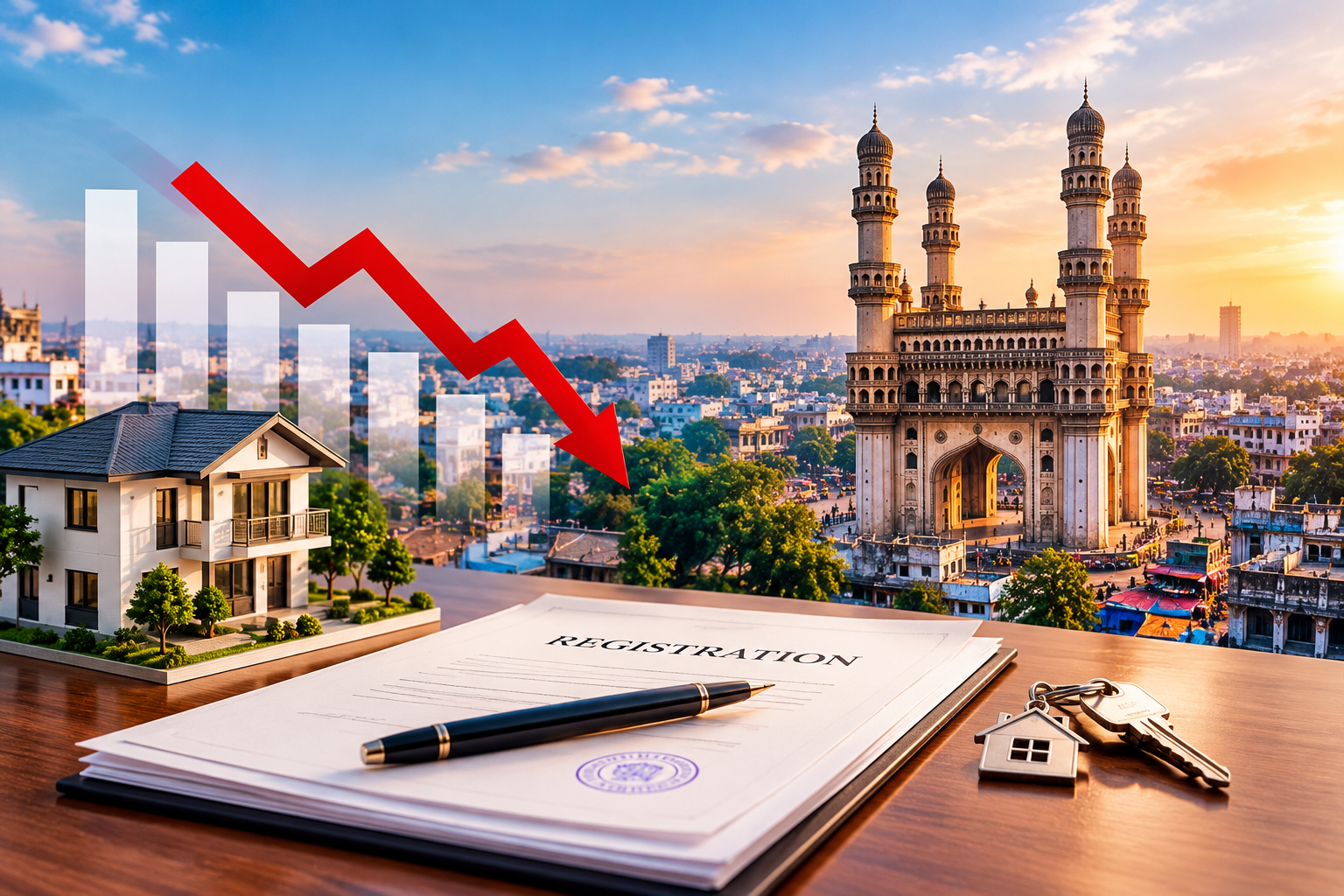
In September 2026, residential property registrations in Hyderabad plummeted 15% year-on-year (YoY) to 5,620, while registered sales decreased by 7% to ₹4,487 crore, according to Telangana government data compiled by Knight Frank India.
In September 2025, 6,612 properties were registered, valued at ₹4,804 crore. On a month-to-month (MoM) basis, property registrations in September 2026 declined by 5% to 5,620 from 5,937 in August 2026. The value of registered properties decreased by 2% to ₹4,487 crore from ₹4,804 crore.
The Hyderabad residential market comprises four districts: Hyderabad, Medchal-Malkajgiri, Rangareddy, and Sangareddy, and includes transactions from both the primary and secondary real estate markets.
According to Knight Frank, monthly registration activity has continued to fluctuate following the volatility surrounding the guidance-value revision. Compared to January to September 2026, property registrations were steady at 55,715 units. However, the value of recorded transactions grew by 4% YoY to ₹39,910 crore.
“Hyderabad’s residential market maintained constant registration volumes from January to September 2026, but the value of registered deals climbed 4% year on year. According to Shishir Baijal, International Partner, Chairman and Managing Director of Knight Frank India, monthly activity in September 2026 is uneven, with registrations down 15% year-on-year and transaction values down 7%.Despite the monthly decline, residences valued above ₹1 crore accounted for 56% of September’s sale value, compared to 54% the previous year. This demonstrates the increased contribution of higher-ticket housing to the total value of registered transactions, even while registration quantities remain low,” Baijal stated.
Home Price and Size Trends
From January to September 2026, property registrations remained essentially steady across ticket sizes. Registrations for residences priced below ₹50 lakh and between ₹50 lakh-₹1 crore remained stable year on year, while registrations for homes above ₹1 crore climbed by 2%. According to Knight Frank India, the value of properties in the below-₹50 lakh segment increased by 2%, the ₹50 lakh-₹1 crore segment stayed stable, and the luxury segment had 6% rise.
In September 2026, registrations for all ticket sizes decreased. Registrations for properties priced below ₹50 lakh fell 20% year on year, while those priced above ₹1 crore fell 12% and those priced between ₹50 lakh and ₹1 crore fell 6%. Transaction values decreased in all three sectors, with the premium category experiencing a 2% decrease compared to 15% in the below-₹50 lakh segment and 8% in the ₹50 lakh-₹1 crore segment, according to data.
According to Knight Frank data, residences between 1,000 and 2,000 square feet accounted for the majority of registrations (66%) in September 2026. Units larger than 2,000 square feet accounted for 18% of the transactions in September 2026.
Since 2017, MahaRERA has issued ₹1,037 cr in recovery warrants against developers, with 45% recovery rate, the highest in India.
On October 15, Maharashtra Real Estate Regulatory Authority (MahaRERA) reported recovering ₹369.45 crore in compensation for homebuyers across 273 real estate projects. In the last 9 years, 516 recovery warrants worth ₹1,037 crore were issued to developers. The Mumbai real estate market had the largest recovery of dues, according to the government.
According to MahaRERA, its compensation recovery rate is 45%, making it the leading RERA authority in India in terms of compensation obtained for homebuyers.
What is a recovery warrant?
MahaRERA issues recovery orders against real estate developers who fail to deliver over property possession to homebuyers on time. Recovery warrants must be executed by the area’s district collectors.Since May 2017, MahaRERA has issued ₹1,037.86 crore in recovery orders to compensate 1,531 complainants. Of this sum, cases involving ₹104.70 crore are pending before the National Company Law Tribunal (NCLT), while cases involving ₹104.46 crore fall under the Maharashtra Protection of Interest of Depositors (in Financial Establishments) Act, 1999. MahaRERA stated that recovery proceedings for roughly ₹209.16 crore are currently prohibited.
Mumbai leads in collection.
MahaRERA has recovered ₹369.45 crore from District Collectorates, with Mumbai leading the way with ₹228 crore.
Data shows that ₹142.31 crore was recovered from the Mumbai Suburban area, followed by ₹85.80 crore from the Mumbai City district, ₹68 crore from the Pune district, ₹36 crore from the Thane City district, and ₹12 crore from the Alibaug district.
The MahaRERA reported that Nagpur district collected ₹9.65 crore, Palghar recovered ₹4.90 crore, Nashik ₹4.90 crore, Chhatrapati Sambhaji Nagar ₹3.84 crore, Sindhudurg ₹54 lakh, Solapur ₹12 lakh, and Chandrapur ₹9 lakh, bringing the outstanding compensation amount to zero.
Highest dues in Mumbai and Pune.
MahaRERA data shows that of the total ₹1,037 crore in recovery warrants issued in Maharashtra, the highest due amount is ₹878 crore from Mumbai and Pune. The Mumbai suburban district owes ₹415 crore, followed by ₹231 crore in Mumbai city and ₹230 crore in Pune.
Data shows that districts including Thane, Alibaug, Palghar, and Nagpur have recovered warrants valued over ₹146 crore.

Maharashtra is considering a major change in the way property developers collect money from homebuyers.
The state government is planning an amendment that could restrict developers from collecting more than around 75–80% of the property’s total consideration before the project’s final completion and registration. The remaining amount could be retained by the buyer until the final registration stage.
The proposal is aimed at reducing the financial risk faced by homebuyers, particularly those purchasing under-construction properties.
The development is important for Mumbai because the city’s property market has a large under-construction segment, where buyers often commit substantial amounts of money years before receiving possession.
According to recent reporting, the Maharashtra government is looking at amendments to the Registration Act that could prevent developers from taking the entire property consideration before completion. The exact percentage and implementation mechanism will depend on the final legislation or notification.
What Is the Proposed 80% Rule?
Under the proposal being discussed, a developer may be allowed to collect only around 75–80% of the property’s total consideration before final registration.
For example, suppose a homebuyer purchases a flat worth ₹1 crore.
Under a possible 80% framework:
- Property value: ₹1 crore
- Maximum amount before final registration: around ₹80 lakh
- Amount retained until registration: around ₹20 lakh
The exact structure should not be assumed until the government formally notifies the provision.
The key idea is that the buyer would retain a meaningful financial stake until the property reaches the final stage of the transaction.
Why Is This Important for Homebuyers?
Buying an under-construction home involves a major financial risk.
A buyer may begin paying for the property while construction is still underway. If the project faces delays, approval problems, funding issues or other difficulties, the buyer may have already paid a significant portion of the purchase price.
The proposed mechanism could change that risk equation.
If 20% of the consideration remains payable until final registration, buyers may have greater financial leverage during the final stage of the transaction.
This does not eliminate project risk.
It also does not mean buyers should stop checking the developer’s track record or project documents.
Instead, it could become an additional layer of protection.
What Could It Mean for Mumbai Buyers?
Mumbai has one of India’s most expensive residential markets.
For a ₹2 crore apartment, 20% represents ₹40 lakh.
For a ₹3 crore apartment, it represents ₹60 lakh.
Therefore, even a relatively small change in the payment structure could have a substantial financial impact on buyers.
For example, a buyer who is purchasing a ₹2 crore under-construction apartment could potentially retain around ₹40 lakh until the final registration stage if the final rule establishes an 80% threshold.
That could reduce the amount of money exposed before the property reaches its final legal and completion stage.
Will This Stop Delays?
Not necessarily.
This is one of the most important points homebuyers should understand.
A payment restriction cannot by itself guarantee timely possession.
Construction delays can happen because of approvals, financing, litigation, contractor issues, changes in plans or other circumstances.
The buyer must therefore continue to examine the possession date, construction progress and contractual remedies.
MahaRERA itself requires promoters to keep important project information updated, including construction progress, building details, documents, encumbrances and completion dates.
What Should Buyers Check Before Booking?
Even if the proposed rule becomes law, buyers should conduct their own due diligence.
1. Check MahaRERA Registration
Search the project on the official MahaRERA portal.
MahaRERA provides facilities for homebuyers to search registered projects and access project-related information.
2. Check the Completion Date
Don’t rely only on a sales representative’s verbal promise.
Compare the proposed possession date with the project’s official MahaRERA information and the Agreement for Sale.
3. Read the Agreement for Sale
The agreement should clearly specify the property, carpet area, consideration, payment schedule, possession terms and other important obligations.
4. Check Approvals
Buyers should verify whether the relevant approvals and commencement certificates are in place.
MahaRERA’s project-registration requirements include approvals, commencement certificates, sanctioned plans, project details and the proposed Agreement for Sale.
5. Examine the Developer’s Track Record
A large brand name should not replace due diligence.
Look at previous projects, delays, litigation, possession history and customer complaints.
Could Developers Be Affected?
The proposed rule could also change developers’ cash-flow planning.
Under the traditional construction model, customer collections are an important source of project funding.
If a portion of the consideration remains outstanding until final registration, developers may need stronger project-level financial planning.
This could potentially favour financially stronger developers who have access to institutional finance and other sources of capital.
Smaller developers may need to adapt their funding models.
Is the 80% Rule Already Law?
This distinction is extremely important.
No homebuyers should not treat the proposal as an already applicable rule.
The current reports describe a proposed change being considered by the Maharashtra government. The final percentage, conditions, applicability and effective date will depend on the government’s formal legal process.
Therefore, buyers should check the latest government notification before assuming that they can legally withhold a particular amount.
What Should Existing Buyers Do?
Existing buyers should not independently stop making scheduled payments simply because the proposed rule has been reported.
The payment obligations under their existing Agreement for Sale remain important.
If there is a dispute regarding payment, possession or construction, buyers should obtain professional legal advice and examine the applicable RERA provisions and contractual terms.
Bottom Line
Maharashtra’s proposed payment restriction could become an important development for homebuyer protection.
If implemented, retaining around 20% of the property consideration until final registration could give buyers greater financial leverage and reduce the amount of money paid before a project reaches its final stage.
But the proposal should not be viewed as a replacement for due diligence.
For Mumbai homebuyers, the safest approach remains the same: verify MahaRERA, check approvals, study the Agreement for Sale, investigate the developer’s track record and understand the payment schedule before committing large amounts of money.

SRA Removes Malvani Builder After 17 Years

Hyderabad Property Registrations Drop 15% in September 2026

Ratnagiri to Get Maharashtra’s Fifth Film City

43,000 Homes Unsold in Navi Mumbai Amid Buyer Slowdown

Vijayta Raheja Applauds India’s ₹4 Lakh Crore Urban Vision at ET Maharashtra Business Summit

K Raheja & IHG Team Up to Elevate Powai’s Hospitality Landscape
-
 Real Estate News6 months ago
43,000 Homes Unsold in Navi Mumbai Amid Buyer Slowdown
-
 Real Estate News6 months ago
Vijayta Raheja Applauds India’s ₹4 Lakh Crore Urban Vision at ET Maharashtra Business Summit
-
 New Projects & Launches6 months ago
K Raheja & IHG Team Up to Elevate Powai’s Hospitality Landscape
-
 Real Estate News6 months ago
Mumbai’s Largest MHADA Redevelopment Drive Set to Transform 923 Acres
-

 NRI Real Estate7 months ago
Will NRI Investments Drive Mumbai Housing?
-

 Global Real Estate7 months ago
Spanish Youth Hostel Group Considers London Real Estate Deals
-

 NRI Real Estate7 months ago
How NRIs Are Driving India’s Property Market?
-

 Real Estate News7 months ago
John Abraham Firm Renews Bandra Rent at ₹12L/Month