None of Pakistan’s Prime Ministers has lasted five years. The present Prime Minister’s decision to award Asim Munir 5 years demonstrates that Pakistan’s military dictatorship is the most inventive in history.
Since the twentieth century, the globe has experienced a number of uniformed tyrants. No other country has developed as much innovation in military governance as Pakistan.
The most recent is the notification appointing Asim Munir as Army Chief and Chief of Defence Forces for the next five years. Any Pakistani cadet who enters the academy can aspire to be the country’s ruler. However, Munir has now pulled off an astonishing invention, even by Pakistan Army standards.
View it this way. In 75 years, none of Pakistan’s 29 prime ministers (Liaquat Ali Khan being the first) has served a full five-year term because the Army refused to let it. Nonetheless, Munir has convinced his current prime minister to designate him CDF for five years.
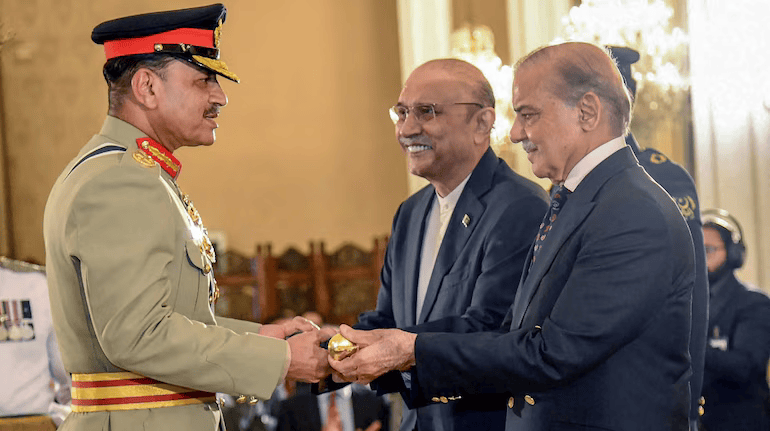
It is not an irony or absurdity worth laughing at. This is a military dictatorship’s innovation equivalent of what Tesla or Palantir would have accomplished in the technology arena. First, Munir persuaded the Sharifs to name him chief a day before his retirement, when the incumbent (Qamar Javed Bajwa) was still in office. As a result, Pakistan had two active chiefs for two days. His three-year tenure ended on November 28, thus he retired that day, but he remained chief for a week after receiving notification that he had been appointed CDF and Army head. I assume it is retrospective, or an auditor may object to his compensation for the week he was unemployed. Of course, it will be a brazenly cheeky auditor.
Please stay with me. He first rigged the 2024 election by imprisoning Imran Khan and his wife, preventing his party from running, and then appointing his preferred prime minister, Shehbaz Sharif. Now, he persuaded the same prime minister to first promote him to field marshal, then mutilate his republic’s constitution with the 27th amendment, which made the field marshal’s job permanent, established the CDF as the boss of all armed forces with a five-year tenure and lifelong immunity from prosecution. A two-year extension was offered to the air chief, who has already served an extended term since March 2024.
To summarize, the general was appointed field marshal for life with immunity, then CDF for five years following the completion of his three-year service as chief—all under an elected prime minister, parliament, and a constitution revised by members chosen in an opposition-free election. Pakistan’s constitution and parliament have consecrated the most recent military dictator in the country’s history, and the prime minister and president have notified them. It’s as if the two men elected to the country’s highest offices signed political death certificates for themselves.
The civilian administration summoning the general to power is not unprecedented in Pakistan. In 1958, civilian President Iskander Mirza declared martial law and named General Muhammad Ayub Khan as Chief Martial Law Administrator (CMLA). Ayub sacked Mirza, became president, and selected Muhammad Musa Khan, a bland, non-threatening general, as army head. But how could a general report to another general? He promoted himself as a field marshal. Musa lived till 1966. This also started the trend of Pakistani army chiefs having long tenures. For example, Pakistan has only had 17 army commanders, whereas India currently has 31. By the time Munir completes his tenure in 2030, India will have its 33rd.
Ayub devised party-less, ‘guided democracy,’ held a fraudulent election, and even managed to unseat Mohammed Ali Jinnah’s sister, Fatima. He handed over to General Yahya Khan. Yahya’s hybrid government includes Zulfiqar Ali Bhutto as foreign minister. He also held an election. However, because the “wrong” side, Mujibur Rahman’s Awami League, won, he disregarded the results. Following him, Bhutto briefly declared martial law in 1977, but General Zia removed, imprisoned, and killed him. Zia then attempted to usher in an Islamic regime (Nizam-e-Mustafa), followed by a party with less democracy through a staged election, and then removed even the elected prime minister, Mohammed Khan Junejo. With the C-130 crash or bombing in Bahawalpur on August 17, 1988, history lost more of his ‘imaginative’ notions.
Since then, a general has been directly in command (Pervez Musharraf, 1999-2007), managing authority from the outside, or leading from behind, routinely cadging extensions. Until Munir arrived with a new and improved screenplay.
We skip going into deeper detail on the many colorful arrangements in Pakistan and instead apply this argument to the entire Subcontinent. Far from motivating other military strongmen in the Subcontinent, Pakistan’s example has persuaded them to take the opposite approach. As we can see, everyone has rejected political power in favor of democracy. We’re talking about Bangladesh, Sri Lanka, Nepal, and the Maldives. Even in Bhutan, the emperor established a democratically elected government and delegated enormous power to his elected prime minister. All of them have rejected Pakistan as an example.
They are all safer, more stable, and already twice (Bangladesh), two and a half times (Bhutan), three times (Sri Lanka), or eight times (Maldives) as wealthy per capita as Pakistan. Even Nepal has caught up and will soon overtake Pakistan, thanks to its somewhat higher GDP growth rate and significantly lower birth rates. Pakistan is the Subcontinent’s biggest loss because competitive politics and democracy, no matter how messy, produce better results than dimwit military rulers.
Each country provided opportunity for generals. In Bangladesh, two generals ruled. However, the events and background surrounding General Ziaur Rahman’s coup in 1977 were unusual. It was based on the contentious history of the Bangladesh liberation war. While Mujib was imprisoned in West Pakistan, Zia, then a major, led the uprising with other young Bengali officers on the night of the Pakistani crackdown (Operation Searchlight), March 25, 1971, shooting his East Bengal Regiment’s Punjabi commandant, Lt Col Abdur Rashid Janjua. He believed he announced the new republic in a wireless radio broadcast at 7.45 p.m. on March 27, much earlier than Mujib. Mujib had just been captured and transported to West Pakistan.
Mujib, too, became autocratic, and his death and multi-stage military takeover were orchestrated by relatively young officers. Zia, the current head, took command in 1977 and was slain by young officers in 1981. After a brief civilian interregnum, General H.M. Ershad governed (1983-90), but democratic opposition eventually destroyed him. All major parties, including arch rivals Sheikh Hasina and Khaleda Zia, worked together to remove him and restore democracy. He spent time in jail after being convicted of corruption. Bangladesh rebounded from these setbacks, and its army, having learned its lessons, became a staunch supporter of democracy.
Over the last two years, public movements have deposed profoundly unpopular and elected administrations in Sri Lanka, Bangladesh, and Nepal. In each, a general could easily have taken command. Instead, they all used the army to provide confidence in the midst of upheaval, while also promoting orderly civilian transitions and elections. In Bangladesh, the country most likely to be affected by the Pakistani military, the most political comment you’ve heard from its leader is a polite reminder that elections should be conducted sooner rather than later.
This is the three-example rule in journalism. Munir has been solidifying authority at the same time that his colleagues in Sri Lanka, Bangladesh, and Nepal have avoided it with extraordinary dignity and expertise. Each of these countries is performing better than Pakistan. And if your country is doing so well, it doesn’t matter if no one (including me) remembers the name of its army leader. The disadvantage is that Donald Trump would not recognize your chief as his favorite field marshal. Isn’t that something worth celebrating?



 Asim Munir and Pakistan’s Failed Marshal Doctrine.





No Comments